For a while I toyed with the idea of writing corrections of Supreme Court opinions which are often wrong and, even when the results are right (e.g. A Libertarian Defense of Kelo and Limited Federal Power), the reasoning is typically often still confused, muddled, statist, legal-positivist, anti-decentralist (anti-antifederalist), and economically illiterate (other than that, it’s just fine). I would play Shadow Justice. Great use of my time. See, e.g., my short-lived blog The Shadow Justice which I discontinued because I was lazy too busy.
 Anyway in a recent case, Learning Resources, Inc. v. Trump (Feb. 2o, 2026), 1 the Supremes struck down Trump’s use of the International Emergency Economic Powers Act (IEEPA) to impose tariffs, holding that IEEPA does not authorize the President to impose tariffs. (I also thought Roberts was basically right to conclude that Obamacare’s mandatory fees are permissible, by characterizing them as a “tax.” Unfortunately.)
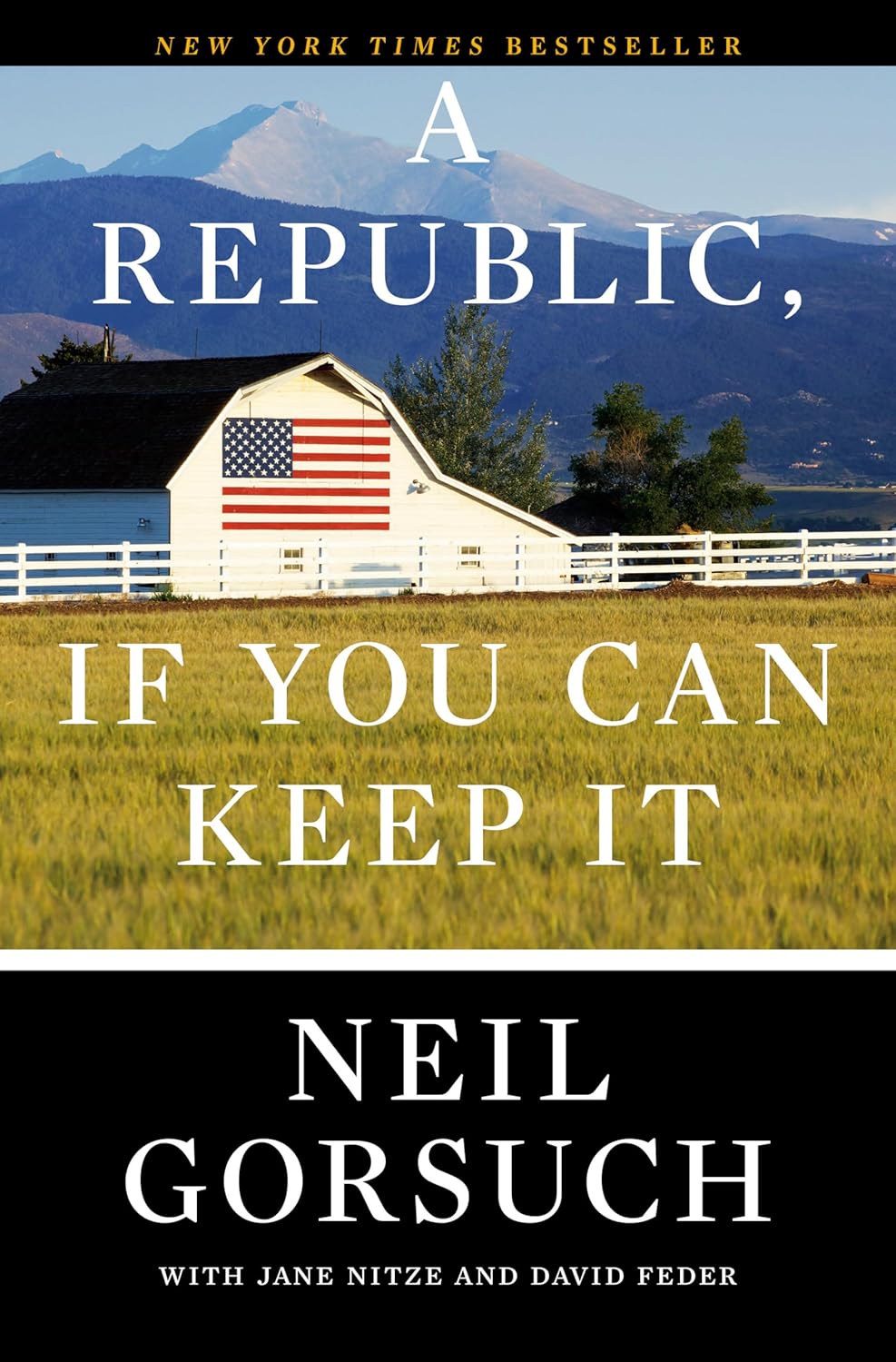
I have long thought Thomas was overall the best modern Supreme Court justice–best in the sense of honesty and originalism—even though he is not always right either legally or from a libertarian perspective. Since reading Neil Gorsuch’s book A Republic, If You Can Keep It (2019) (I ain’t read his Over Ruled: The Human Toll of Too Much Law (2024) yet), and from reading some of his subsequent opinions, I’ve begun to think think he might be as good or better than Thomas.
In this case, I think the majority decision sounds about right, especially Gorsuch’s sensible concurrency, which rightly chastises the three democrat fake-judges who rejected the broad interpretation of IEEPA even while claiming to still reject the “major questions doctrine” the conservative majority has been crafting in recent years to strike down other excessive and unconstitutional grants of power by Congress to regulatory agencies (also why the President ought to be able to fire any employee of the executive branch). (As much as any interpretation by fake judges of fake “law”—legislation, including the written Constitution—can be “wrong” or “right,” 2 other than being just/libertarian or not, based on its consequences and compatibility with libertarian principles of justice. 3 ) His justification for the major questions doctrine in Part I of his concurrence, and his criticism of the incoherence of the three liberal justice (only one of whom seems to be of above-average intelligence) makes sense. As he notes:
The major questions doctrine performs a similar function. Article I vests all federal legislative power in Congress. But like any written instrument, federal legislation cannot anticipate every eventuality, a point my concurring colleagues have observed in the past. Id., at 781–782. And highly resourceful members of the executive branch have strong incentives to exploit any doubt in Congress’s past work to assume new power for themselves. The major questions doctrine helps prevent that kind of exploitation. Our founders understood that men are not angels, and we disregard that insight at our peril when we allow the few (or the one) to aggrandize their power based on loose or uncertain authority. We delude ourselves, too, if we think that power will accumulate safely and only in the hands of dispassionate “people . . . found in agencies.” Id., at 781. Even if unelected agency officials were uniquely immune to the desire for more power (an unserious assumption), they report to elected Presidents who can claim no such modesty. See Myers v. United States, 272 U. S. 52 (1926).
As does his criticism of Barrett’s “suggest[ion, in her concurrence,] that the major questions doctrine might be reconceived.” I was impressed by Barrett’s composure and lack of notes in her confirmation hearings, but how I’m thinking she may be intellectually a step below Gorsuch and Thomas, more on the level of the frat-boy (Kavanaugh) but still above the two liberal DEI appointees, Sotomayor and Jackson) (Kagan seem smart but mired mostly in statist thinking). And in Part III, he criticizes the dissenters (Kavanaugh, joined by Justices Clarence Thomas and Samuel Alito) for accepting the major questions doctrine but that the Court “shouldn’t apply the major questions doctrine to any statute, like IEEPA, that implicates ‘foreign affairs.'” Gorsuch seems right that the dissent’s reasoning seems strained:
To arrive at that conclusion, the dissent consults four clues we have sometimes employed in our major questions cases to help assess whether a statute clearly authorizes an asserted power. … The dissent formulates these clues largely as I would. … But, to my eyes, the dissent engages in a little grade inflation when applying them.
Gorsuch’s reasoning here seems compelling:
On this score, I share a limited point of agreement with the dissent. Like the nondelegation doctrine, the major questions doctrine protects Article I’s Vesting Clause and, for that reason, the doctrine does not apply where the President is exercising only his own inherent Article II powers. Like the nondelegation doctrine, too, the major questions doctrine may speak with less force where the President and Congress enjoy “overlap[ping] . . . authority.”
Doubtless, cases implicating overlapping powers can arise in the field of foreign affairs. The Constitution, for example, vests in Congress the power to raise and regulate armies, but it also vests in the President the commanderin-chief power. Compare Art. I, §8, cls. 12–14, with Art. II, §2, cl. 1. Similarly, Congress enjoys the power to regulate foreign commerce, but the President has power to negotiate treaties and nominate ambassadors. Compare Art. I, §8, cl. 3, with Art. II, §2, cl. 2. The President may even enjoy some “residual” powers pertaining to foreign affairs under Article II’s Vesting Clause endowing him with the “executive Power.” … Given all this, it is easy enough to imagine statutes and disputes under them that implicate both congressional and presidential powers where we might have reason to question whether the major questions doctrine applies with its usual force.
The problem for the dissent is that none of this is relevant here. Before us, the President concedes that he does not enjoy independent Article II authority to impose tariffs in peacetime. Ante, at 18–19. Nor does the President claim “‘concurrent’” constitutional authority to issue his tariffs. Ante, at 13 (citing Tr. of Oral Arg. 70–71). Instead, and to his credit, the President admits the power to authorize tariffs in peacetime is constitutionally vested in “Congress alone.” Ante, at 13 (internal quotation marks omitted). Therefore, the President relies entirely on power derived from Congress, and that means the major questions doctrine applies in the normal way.
… This new exception to the major questions doctrine would have (enormous) consequences hard to reconcile with the Constitution.
… The dissent’s exception is so broad it’s hard not to wonder how it fits with some of our existing major questions precedents.
As he concludes Part III’s critique of the 3 Kavanaugh dissenters:
Before us, the President insists he may use IEEPA to equalize foreign and domestic duties—or not. He may use it to negotiate with foreign countries—or not. He may set tariffs at 1 percent or 1,000,000 percent. He may target one nation and one product or every nation and nearly every product. And he may change his mind at any time for nearly any reason. At least as I see it, history dating “back to near the Founding,” post, at 59, does not support the notion that Presidents have traditionally enjoyed so much power. More nearly, history refutes it.
His critique, in Part IV, of Thomas’s separate dissent also seems sound. Thomas would permit Congress to “hand over most of its constitutionally vested powers to the President completely and forever.” This “would require us to reimagine much of our case law addressing Article I’s Vesting Clause,” and has various difficulties that Gorsuch adumbrates. His concurrence reads like an intelligent, common sense civics lesson and caution against ignoring the tripartite separation of powers in the Constitution—which is also the basis for rejecting Chevron‘s deference to admistrative agency power and the argument that the President must have the power to terminate any executive branch employee, including those of the Federal Reserve. Though I doubt even Ole Gorsuch will have the balls to rule this way this when this has to be decided. They will probably make an exception for the Fed. You know, because… I dunno. They need the money that pays their paychecks to remain viable. And, I dunno, Epsteinian “prescription” or something. 4
So on this one, Gorsuch > Thomas.
Update: on the latest (and generally excellent) Advisory Opinions podcast, with Supreme Court Strikes Down Trump Tariffs” (
- See Amy Howe, “Supreme Court strikes down tariffs,” SCOTUSBlog (Feb 20, 2026); Learning Resources, Inc. v. Trump (Tariffs); Learning Resources, Inc. v. Trump, 607 U.S. ___ (2026) (Justia); pdf. [↩]
- Hasnas: Common Law, Anarchy, etc.: Common Law Liberalism: A New Theory of the Libertarian Society; KOL457 | Sheldon Richman & IP; Andre from Brazil re Contract Theory, Student Loan Interest Payments, Bankruptcy, Vagueness, Usury; Covid Emergency Declaration in Louisiana Strips Citizens of Right to Sue for Negligence; Down with the Bill of Rights: Heller and the Central States Cheerleaders (2008); KOL199 | Tom Woods Show: The State’s Corruption of Private Law, or We Don’t Need No Legislature; The Superiority of the Roman Law: Scarcity, Property, Locke and Libertarianism; California Gay Marriage Law Overturned: What Should Libertarians Think? [↩]
- The Universal Principles of Liberty; Higher Law. [↩]
- See discussion of this in Using International Law to Protect Property Rights and International Investment. [↩]


