I was raised in Ascension Parish, in Galvez/Prairieville, Louisiana, which is next to Gonzales, the soi-disant Jambalaya Capital of the World—it has held its annual Jambalaya Festival annually since 1968. And yes, we specialize there in Cajun, or brown, jambalaya—similar to African/Nigerian jollof rice—not the Creole or “red” jambalaya made with tomato paste and more popular in New Orleans and other parts. 1
As I noted in my little biography, 2 I attended private Catholic schools in East Baton Rouge Parish—St. George Elementary and Catholic High School—from first grade through high school, unlike my brother and sister and all the local kids, who attended the local public schools, such as Galvez Elementary and St. Amant High School.
Although I did not know many of the local kids well since I did not attend the local schools, I knew a few of them. I lived at home with my parents through most of my 8 years at LSU but did live in an apartment near campus one semester during the first year (1983 or so), with my CHS classmate and childhood friend, John Caffarel. Somehow we ended up sharing a 2 bedroom apartment with with two guys from Ascension Parish and St. Amant High, Mike Brock and Fernando Muñoz. I can’t remember how this happened; perhaps I knew Brock since he lived not far from me. I got to know Mike and Fernando better as we were apartment mates.
My now-wife, Cindy, had moved with her family from Pennsylvania/Delaware to Ascension Parish when she was young, and attended St. Theresa, the Catholic Elementary school in Gonzalez, and then St. Amant High. At those schools she befriended Fernando. When I was rooming with Brock and Fernando, Cindy was dating Brock. In fact I briefly dated her dorm-mate Jesse Meyers, another St. Amant girl.
Cindy broke up with Brock and eventually we started dating and married in 1993. Fernando ended up finishing college at UT-Arlington. We both remain longtime friends with Fernando, whom Cindy and her friends had long ago nicknamed Moon or Moon-Pie. Of course over the years Fernando was exposed to my incessant chattering and arguments about religion, philosophy, libertarianism, and so on.
During one visit, around 2007, during a visit, he said:
Stephan, you know you always talk about Austrians and Rothbard and you say that these are not well known and not taught in college, but that’s not true; I was taught about Austrian economics, Rothbard, and libertarian theory in college!
 I said no way, Moon-Pie; you must be mistaken. I assure you, they are marginalized figures. You don’t learn sound economics or politics in college. They brainwash you with the mainstream and statist stuff. But he kept insisting. So I said, wait, where did you finish college again? “UT-Arlington,” he said. I said well what class did you learn this in? Comparative economic systems, he said. Do you remember the professor? “Sechrest. Larry Sechrest.” I almost spit out my milk. “Sechrest?!” I said. “I know Larry! He and I have met at Mises Institute conferences!” Larry and I in fact lectured together and contributed papers for a seminar on Adolf Reinach in 2001, 3 and he and I saw each other many times over the years at the Mises Institute. At the time, Sechrest was a professor at Sul Russ University, but he had started teaching at UT-Arlington, where he got his bachelor’s in history and philosophy and his master’s and Ph.D. in economics, before moving to Sul Ross in 1990. 4
So it turns out Fernando was right. He had happened to be exposed during college to one of the very few Austro-libertarian economics professors. He didn’t realize how non-mainstream Rothbard was in academia.
I sent Larry a note about this and he had remembered Fernando well and we got a chuckle out of this. This was maybe 15 years ago, before Larry passed away in 2008.) 5 Larry also sent me a syllabus with the note “Here is evidence of some of what I teach these kids (attached).” (see below)
I recently came across an article by Larry in Liberty when I was adding its back issues to my site, “A Strange Little Town in Texas,” Liberty (Jan. 2004): 29–34, 42, which caused some kind of stir in the press. As his Mises.org obituary noted:
Larry earned his PhD late in life from the University of Texas, Arlington, and immediately went to work teaching. He was person of great charity and optimism, but also courage, as was shown a few years ago when a controversy arose about some of his writing. He had written a hilarious and wonderful essay about the trouble with today’s students, singling out his own students as examples. The essay appeared in Liberty Magazine …. 6
What followed was an amazing spectacle. The locals were very upset. The mayor of Alpine, Texas, got involved and denounced him, as did many others. There was even a “support Sul Ross” parade right there in town, with floats and posters, all to protest the words of Sechrest. The students, the professors, the merchants, everyone, was against Sechrest – except that in private everyone knew he was right and let him know, again privately. It was a sight that H.L. Mencken would have adored.
Then the New York Times got involved … with a huge feature, 7 with interviews with townspeople and many others. Rarely does Alpine make the national news but this one time, all thanks to Larry, who was just one man of integrity who dared tell the truth.
Throughout the ordeal, he showed what he was really made of. He was light and funny and charming, making jokes and tossing off wry one-liners. He didn’t have a heavy heart about it at all. On the contrary, he seemed completely calm and entirely amused by it all. Not once did he back down or back-pedel. He stuck by every word in the piece, and used the occasion to explain ever more.
I mentioned this recently to Fernando who then told me he had found his old notebook from the comparative economic systems course he took under Sechrest. He sent me the scans; I append them below, plus some pix with Moon over the years.


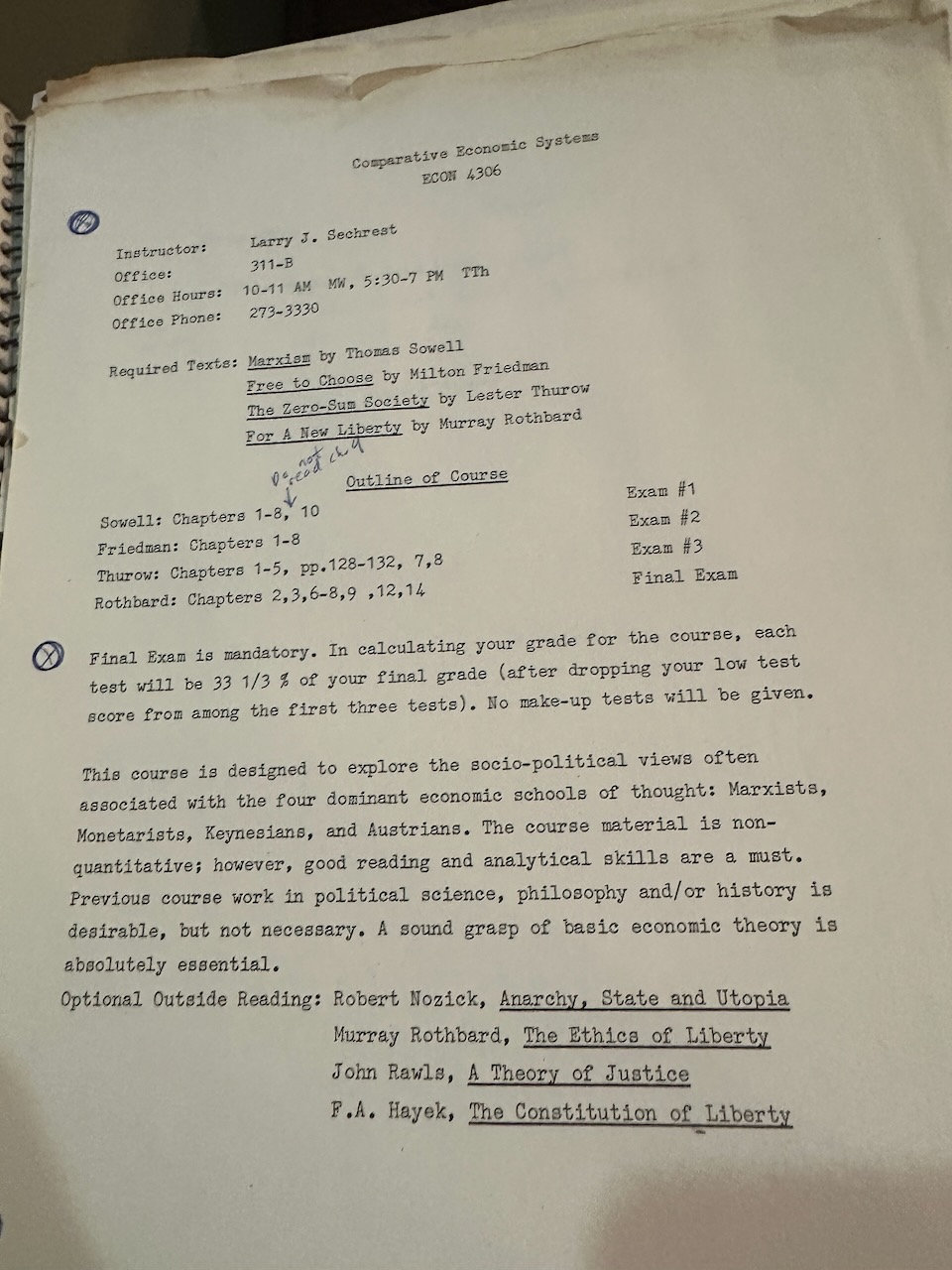
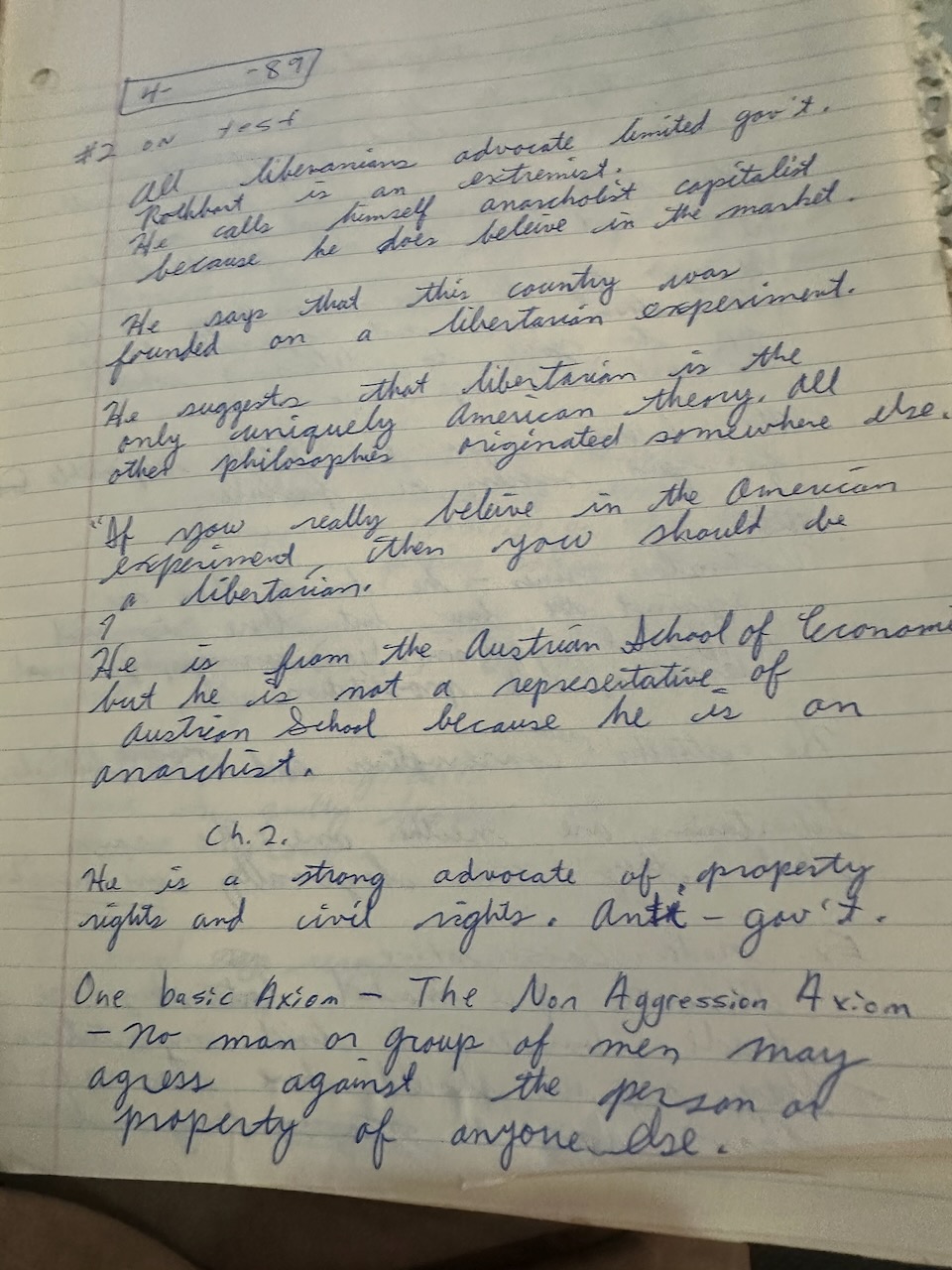
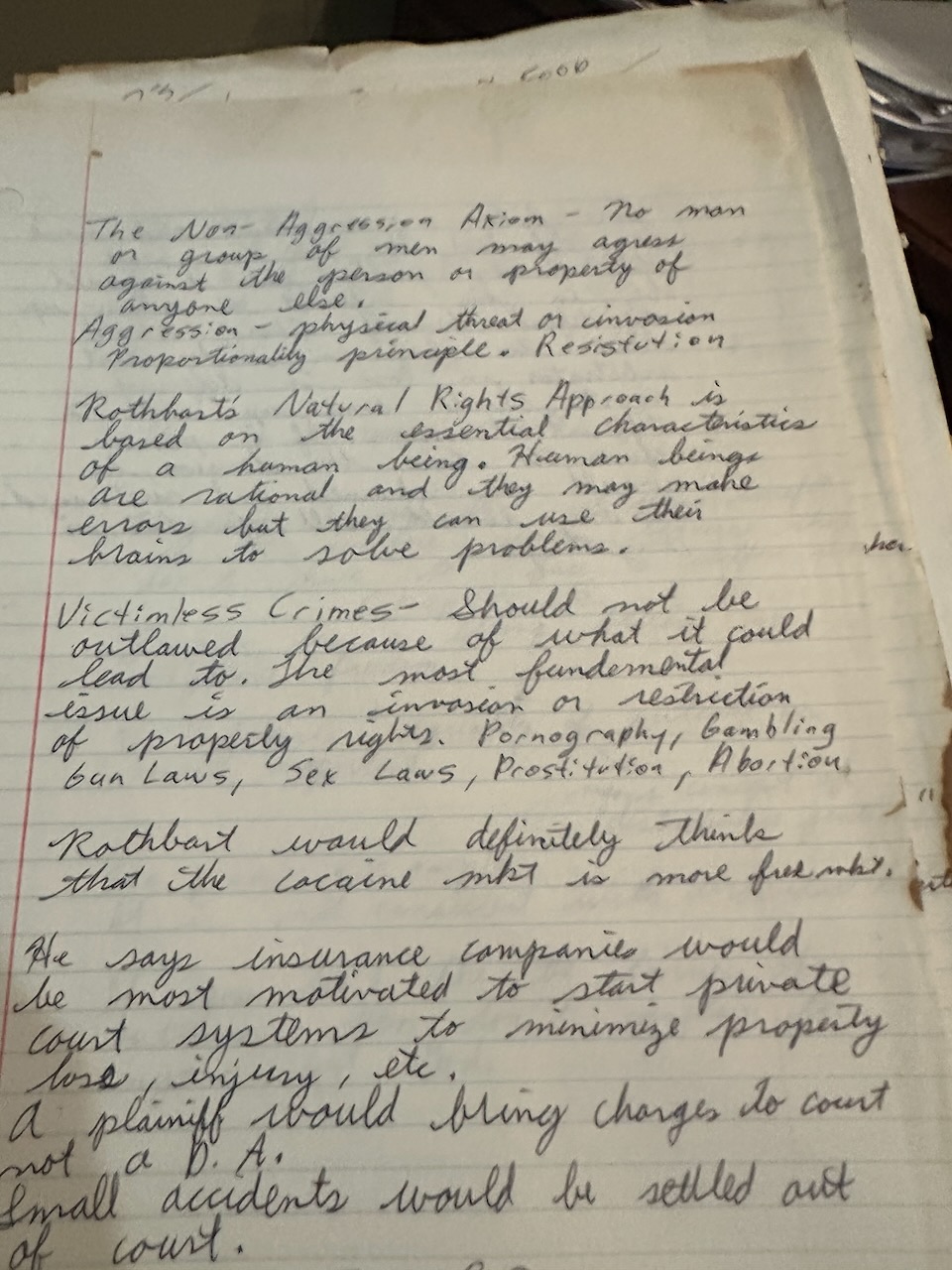
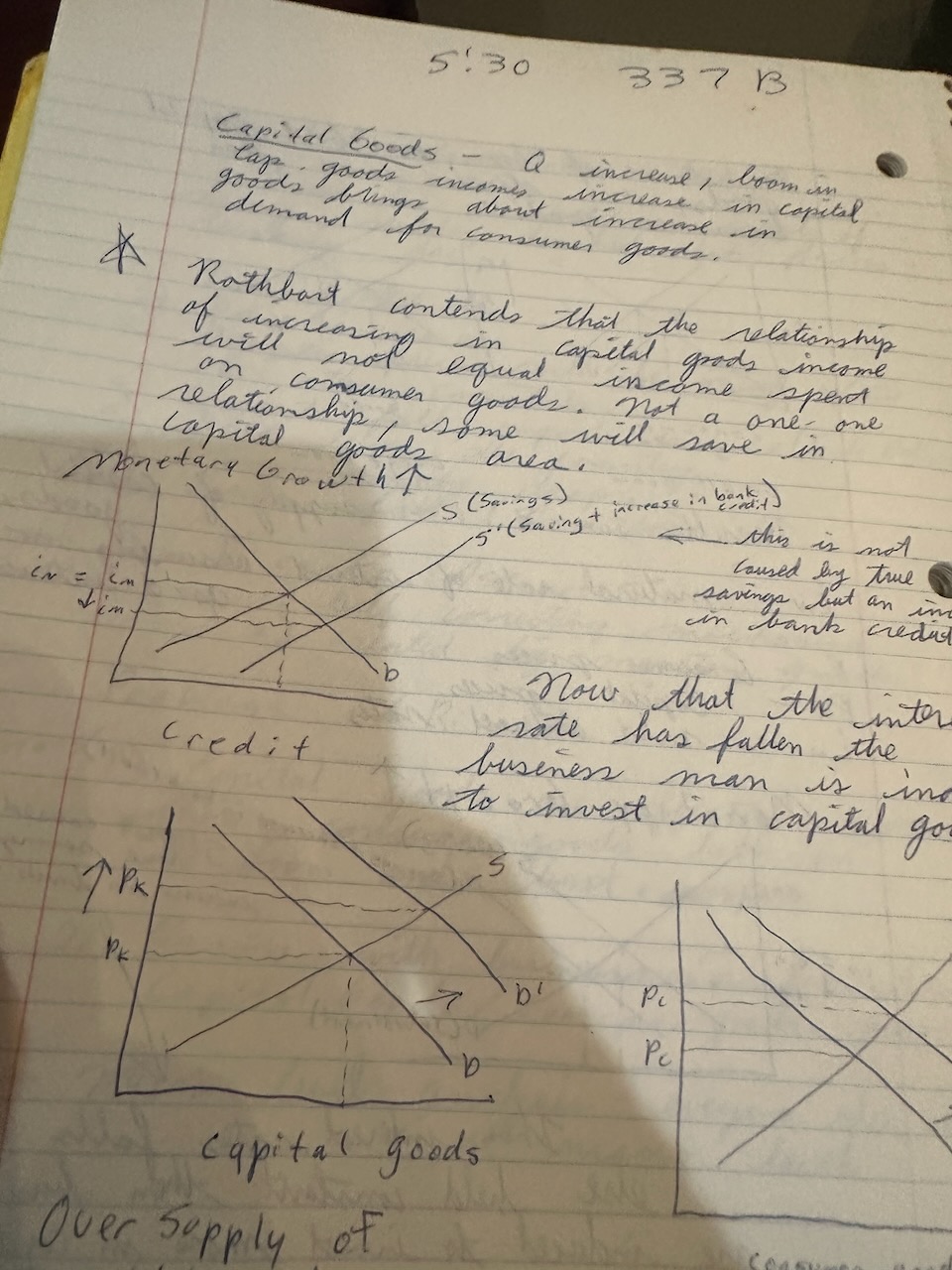
SECHREST SYLLABI, SUL ROSS
As noted above, in 2007 Larry sent me three sample syllabi he had recently used at Sul Ross: ECO 4305H (Honors): Free Markets and Free Minds (Spring 2006; pdf); ECO 5302: Seminar in Economic Issues–Free Enterprise (Summer II 2006; pdf); ECO 5301: Comparative Economic Thought–Free Enterprise (Summer I 2005; pdf), which are each reproduced below.
ECO 4305H (Honors)
Free Markets and Free Minds
Spring 2006
Professor: Dr. Larry J. Sechrest
Office: 309 BAB
Office Hours: 9:30-12:30, M-Th
Office Phone: 837-8069 or 8066
fax: 837-8003 email: [email protected]
Textbook: None. All required reading materials will be in the form of handouts provided by the professor.
Readings: The Godless Constitution by Isaac Kramnick and R. Laurence Moore
“The English Roots of the Secular State”
Common Sense by Thomas Paine
Vices Are Not Crimes by Lysander Spooner
Instead of a Book by Benjamin Tucker
“State Socialism and Anarchism”
“The Relation of the State to the Individual”
“Socialism: What It Is”
“Karl Marx as Friend and Foe”
The Discovery of Freedom by Rose Wilder Lane
“Communism”
“The Planned Economies”
The God of the Machine by Isabel Paterson
“The Humanitarian with the Guillotine”
“Our Japanized Educational System”
The Virtue of Selfishness by Ayn Rand
“Collectivized Ethics”
“Racism”
Drawing the Line by Paul Goodman
“A Touchstone for the Libertarian Program”
“A Causerie at the Military-Industrial”
The Radical Will by Randolph Bourne
“The State”
“Ballots and Bullets” by Murray Rothbard
Power and Market by Murray Rothbard
“Fundamentals of Intervention”
Objective of the course: To acquaint students with an important part of the American intellectual heritage—the current of individualistic, pro-liberty thought that has long flowed through the society, but which is often ignored today. The readings will range across topics as diverse as the right of a free people to revolt against an oppressive government, anarchism, government censorship, war, the welfare state, public education, and the ethical roots of statism. Included will be the views of anarchists, right-wing libertarians, left-wing libertarians, several women, and one gay anti-war activist.
Outline of the Course
| Readings from Kramnick/Moore, Paine, Spooner, and Tucker | Exam #1 |
| Readings from Lane, Paterson, and Rand | Exam #2 |
| Readings from Goodman, Bourne, and Rothbard | Final Exam |
All exams will consist entirely of essay questions. The Final Exam is mandatory but not comprehensive. There will be no makeup tests. If you are absent for one of the tests, you will be required to submit a 10-12 page research paper in place of the test.
Each exam will be worth a maximum of 100 points. Your grade will be determined as follows:
A = 270-300 points
B = 240-269 points
C = 210-239 points
D = 180-209 points
F = 0-179 points
Class attendance, careful note taking, and class participation are essential to success in this course.
The State of Texas mandates that the following be included on all course syllabi:
Students with Disabilities
Qualified students with disabilities needing academic or other accommodations to ensure full participation in the programs, services, and activities at Sul Ross State University should contact the Office of Student Support Services, Ferguson Hall, Room 112, Box C-117, Alpine, Texas 79832, (432) 837-8203.
ECO 5301
Comparative Economic Thought–Free Enterprise
Summer I 2005
Professor: Dr. Larry J. Sechrest
Office: 309 BAB
Office Hours: By Appointment Only
To Arrange an Appointment, Please Call (I have Voice Mail) or Email Me
Office Phone: (432) 837-8069 or 8066
E-mail: [email protected] FAX: (432) 837-8003
Textbooks: Marxism by Thomas Sowell
Free to Choose by Milton and Rose Friedman
For a New Liberty by Murray Rothbard
Outline of the Course
| Sowell, Chapters 1-8, 10 | Exam #1 |
| Friedman, Chapters 1-6 | Exam #2 |
| Rothbard, Chapters 2, 3, 6, 9, 12 | Exam #3 |
Note: Please do NOT read Chapter 9 of the Sowell book until after Exam #1
All three exams will consist entirely of essay questions. Each exam will be worth a maximum of 100 points. Your grade in the course will be determined as follows:
A: 270-300 points
B: 240-269 points
C: 210-239 points
D: 180-209 points
F: 0-179 points
This course is unusual in that it is an amalgamation of economics, philosophy, politics, and history. Previous work in those fields will be helpful. Nevertheless, there are no specific prerequisites for this course. Furthermore, neither math nor statistics will be employed, and no outside reading will be required.
Careful reading of the assigned materials will be essential to success in this class.
All tests should be completed and either e-mailed or faxed back to me by noon on Friday, July 1, 2005. Tests that are turned in late will be accepted—if you have discussed the matter with me and I have agreed to permit it. Of course, if you turn tests in late, I will be compelled initially to give you a grade of “Incomplete” and then later change it to a standard letter grade.
The State of Texas mandates that the following be included on all course syllabi:
Students with Disabilities
Qualified students with disabilities needing academic or other accommodations to ensure full participation in the programs, services, and activities at Sul Ross State University should contact the Office of Student Support Services, Ferguson Hall, Room 112, Box C-117, Alpine, Texas 79832, (432) 837-8203.
ECO 5302
Seminar in Economic Issues–Free Enterprise
Summer II 2006
Professor: Dr. Larry J. Sechrest
Office: 309 BAB
Office Hours: By Appointment Only
Office Phone: 837-8069 or 8066
email: [email protected] FAX: (432) 837-8003
Textbook: None
All readings will be provided by the professor
Outline of the Course
International Trade
“Candlemakers’ Petition” by Frederic Bastiat
“On Foreign Trade” by David Ricardo
“Restraint of Trade” by Frederic Bastiat
The Role of Government
“The Nature of Government” by Ayn Rand
“On the Duty of Civil Disobedience” by Henry David Thoreau
“The Role of Government in a Free Society” by Milton Friedman
Exam #1
Race and IQ
Excerpts from The Bell Curve by Herrnstein and Murray
Free Markets and Economic Knowledge
“The Use of Knowledge in Society” by F. A. Hayek
“The Creative Powers of a Free Civilization” by F. A. Hayek
“Private Property and the Government and the Impracticability of Socialism”
by Ludwig von Mises
Exam #2
Capitalism and Altruism
“The Moral Meaning of Capitalism” by Ayn Rand
“Man’s Rights” by Ayn Rand
“The Moral Foundations of Society” by Margaret Thatcher
Environmental Issues
“Environmentalism Refuted” by George Reisman
“Global Warming: The Origin and Nature of Alleged Scientific Consensus”
by Richard Lindzen
Exam #3
All three exams will consist entirely of essay questions. Each exam will be worth a maximum of 100 points. Your grade in the course will be determined as follows:
A: 270-300 points
B: 240-269 points
C: 210-239 points
D: 180-209 points
F: 0-179 points
Unless you have made different, explicit arrangements with me, all tests should be completed and faxed, emailed, or mailed back to me so that I receive them by noon on August 11, 2006.
The State of Texas mandates that the following be included on all course syllabi:
Students with Disabilities
Qualified students with disabilities needing academic or other accommodations to ensure full participation in the programs, services, and activities at Sul Ross State University should contact the Office of Student Support Services, Ferguson Hall, Room 112, Box C-117, Alpine, Texas 79832, (432) 837-8203.
- See A Short Tour of Louisiana Jambalaya. [↩]
- Alan D. Bergman, Adopting Liberty: The Stephan Kinsella Story (2025). [↩]
- My paper was “Reinach and the Property Libertarians on Causality in the Law,” presented at “Reinach and Rothbard: An International Symposium,” Ludwig von Mises Institute, Auburn, Alabama, March 29-30, 2001. Larry’s was Larry J. Sechrest, “Praxeology, Economics, and Law: Issues and Implications,” Q. J. Austrian Econ. 7, no. 4 (Winter 2004): 19–40. The other presenters were Walter Block, Guido Hülsmann (also the director), Hans-Hermann Hoppe, and Barry Smith. For further details see Causation and Aggression (2004). [↩]
- Michael Hall, “Class Warfare,” Texas Monthly (June 2004); Wikipedia, Larry J. Sechrest. [↩]
- Larry Sechrest, 1946-2008. [↩]
- “A Strange Little Town in Texas,” Liberty (Jan. 2004): 29–34, 42. The March 2004 issue of Liberty includes letters responding to Sechrest’s article. [↩]
- Barbara Novovitch, “It’s Home Stupid Home, But the ‘Clods’ Can Read,” New York Times (Feb. 17, 2004). See also Wikipedia, Larry J. Sechrest; Hall, “Class Warfare“; Brian Micklethwait, “Larry Sechrest gets into some Texan bother,” Samizdata (London) (Feb. 17, 2004); Larry Sechrest, 1946-2008. [↩]


How did Prof. Sechrest get away with teaching those topics at a public university, ha ha?
Hello, Moon-pie. I read it!