 Latest notable terms from this week’s Slate Culture Gabfest and Slate Political Gabfest (feel free to email me suggestions or leave them in the comments to the main page): [continue reading…]

Latest notable terms from this week’s Slate Culture Gabfest and Slate Political Gabfest (feel free to email me suggestions or leave them in the comments to the main page): [continue reading…]
The cool, hip techno-pundits are usually reliably Obama-liberal/libertarian-lite types. A bit California-smug, engineer-scientistic, anti-principled, anti-“extreme.” But okay overall. A soft, tolerant, whitebread bunch.
On the last This Week in Tech, I was pleasantly surprised to hear the always interesting Jason Calacanis voice support for nuclear power; and even more surprised to hear soft-liberal host Leo Laporte echo mild agreement with this. Good for them!
But then they had to revert to form when they, along with Natali Del Conte and Patrick Norton expressed unanimous disapproval of McCain’s Internet Freedom Act, since they are all–“of course”–in favor of net neutrality rules imposed by the FCC. McCain’s proposed statute would block the FCC’s proposed net neutrality rules, which would forbid network providers (e.g. cable companies, telcos, and wireless carriers) from selectively blocking certain types of Internet use. [continue reading…]
Excellent post by Kevin Carson, Gene Quinn: Patent Twit of the Week, criticizing patent attorney-shill Gene Quinn‘s “arguments” for patents.
Related:
Update: See Libertarian Button Pushers and Political Compromise, By Patrick McEwen; Robert Capozzi, Push the Button?; Comment 11684 here (the Ordeal of Hoppe); Stephan Kinsella Ought To Shut His Stupid Cake Hole; Big Government, Thy Name is Privatization (comments).
“I have no idea what it means to “favor the immediate abolition of the state”. I say the state is illegitimate and not justified. What in the world does it mean for it to be “immediately abolished”? I think of the Genie jokes where the guy wishes for something and all kinds of…
— Stephan Kinsella (@NSKinsella) April 12, 2025
that is different i think. he is right that anarchy is our ideal goal and the concerns that it would not be stable are in a sense self-defeating. this is different from my criticism of acontextual button-pushing hypos.
— Stephan Kinsella (@NSKinsella) April 12, 2025
Leonard Read is known for “I, Pencil” essay. But see “I’d Push the Button” https://t.co/Oo5OCCC2Mr. (@RMEbeling discusses it at https://t.co/06er9tmwLy). The question is non-specified, too armchair … but…sure. I’d push the button. Whatever that means (https://t.co/wBqzGTpJ5G)
— Stephan Kinsella (@NSKinsella) March 12, 2021
“I take A’s wood and B’s metal to make a house. Am I the rightful owner of that house?”
Libertarian armchair theorists hate this answer, but it depends. You need to know the context. That’s why you need a trial to examine relevant evidence and decide. And this is why there are…
— Stephan Kinsella (@NSKinsella) August 17, 2025
Some of us “radical” (read: principled) libertarians are sometimes accused of refusing to compromise, refusing to accept incremental movements toward liberty; that we would only accept a magical “push of the button”. Of course, this is not true. I want the income tax abolished, but I would view a reduction in the marginal tax rates as an unambiguous improvement by libertarian standards.
The problem lies in reforms that do not clearly and unambiguosly improve the situation, however minutely; but that might even make things worse, at least for some people. For example, moving to a “flat tax” of 20% (with no deductions at all) would be a good thing for me, and maybe even “overall” (whatever that means), but it would amount to a punitive tax increase on people making, say, $25K a year, who pay almost no income tax now. Such a reform would decrease rights violations for some, and increase it for others. [continue reading…]
An edited version of my reply to a global warming alarmist on another thread:
I’m against the state. I’m against junk science. I’m against science used by liberal arts and women’s studies majors from Brown who now infest the state to advance their anti-capitalist interests.
I believe we are in an interglacial period. I believe the evidence trotted out so far by global warming advocates is spotty and selective, and almost always insincere and agenda-driven, or driven by pure ignorance. I believe that global warming would probably be good, but is not going to happen. I suspect that even if it were happening and even if it were bad, the cost of stopping it would far exceed its damages–that is, that it’s not worth it to stop it; that human survival is more important, ultimately, than environmentalist concerns; moreover, I would never trust the state to make this assessment or to impose the “right” regulations to ameliorate the “problem.”
I think that the global warming advocates are not interested in real science or real debate–they want to just take their temporary popularity in the polls and among the arts & croissant crowd, among the DC jetset bored housewives and ditzy Hollywood stars and parlay that as quickly as possible into legislation sponsored by corrupt pols like Nancy Pelosi. I.e.., they just want to win, right away, as quickly as possible before the public starts to catch on or yet another pseudo-science fad catches its eye.
The primary enemy is the state. Any scheme that involves them as a part of the “solution” to a posited problem is obviously flawed. I have no wish to cooperate with or endorse that criminal gang’s legitimacy. Period.
Note: earlier today I quoted a comment by Mario Rizzo. As Rizzo explains here, he requested that his comment be taken down. Out of respect for Dr. Rizzo, I’ve deleted the substance of my post.
Physicist Howard Hayden, a staunch advocate of sound energy policy, sent me a copy of his letter to the EPA about global warming. The text is also appended below, with permission.
As noted in my post Access to Energy, Hayden helped the late, great Petr Beckmann found the dissident physics journal Galilean Electrodynamics (brochures and further Beckmann info here; further dissident physics links). Hayden later began to publish his own pro-energy newsletter, The Energy Advocate, following in the footsteps of Beckmann’s own journal Access to Energy.
I love Hayden’s email sign-off, “People will do anything to save the world … except take a course in science.” Here’s the letter:
[continue reading…]
Latest Libertarian Papers article: “The Definition of Inflation According to Mises: Implications for the Debate on Free Banking,” by Nicolás Cachanosky.
Abstract: The discussion of what is and what is not inflation has become central among the Austrian economists in their debate between free banking with fractional reserves versus banking with 100-percent reserve. Many Austrians also turn to the writings of Mises to find out what the dean of Austrian Economics thought about inflation, but there is no agreement on the interpretation of his writings either. This article tries to contribute to the interpretation of Mises’ concept of inflation.
[Mises blog cross-post]
The most rational argument I’ve seen for belief in God (and the Christian version, in particular) is the “spiral argument” of Catholicism.
Much better, more rational, than anything I’ve ever seen among Protestants.
And I fail to see how any Protestant can listen to conversion stories like the one of Scott Hahn and not waver.
I listen every week to various conversion stories, on EWTN’s The Journey Home, e.g., and find it fascinating. Dunno why.
Related previous post: The Unidirectionality of Conversions

In “Classical Liberalism versus Anarchocapitalism” (originally published in Property, Freedom and Society: Essays in Honor of Hans-Hermann Hoppe (2009)), Jesus Huerta de Soto provides an excellent chart (above) that I think is superior to the Nolan Chart (below).

See also Tom Knapp’s political spectrum bell curve: “On the far Left (market anarchism) and the far Right (anarcho-capitalism), appetite for political government trails off to zero (which is why “Left” and “Right” libertarians have so much in common).”

Tom Knapp’s Political Spectrum Bell Curve
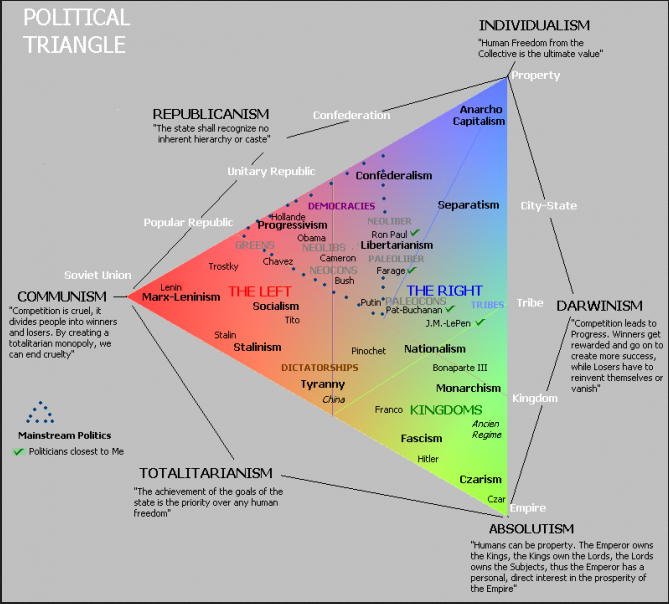
Update: See also the Political Triangle (from Twitter):
 I’m reading Jennifer Burns’s excellent biography of Rand, Goddess of the Market: Ayn Rand and the American Right. She mentions that one of Rand’s first suitors in Russia was a guy named Seriozha. I could not help but be reminded of Rothbard’s derisive term “dimwit and serioso libertarians“.
The recent Board of Patent Appeals and Interferences (BPAI) decision, Ex parte Rodriguez (discussed here), is a good example of the completely arbitrary, artificial nature of patent law. This is what counts as the meat and bones of natural “justice” in the IP world. This opinion discusses the relationship between the Patent Act’s Sec. 112, 6th and 1st paragraphs, and clarifies why and under what conditions a functional claim limitation that is not a means-plus-function recitation may be invalid under Sec. 112, 1st para. for lack of enablement. Blah blah blah.
How anyone can think this is possibly compatible with libertarian principle is beyond me. No offense, Randians.
[AM cross-post]


 Stephan Kinsella is a libertarian writer and retired patent attorney in Houston, Texas. He has published widely on various areas of libertarian legal theory and on legal topics such as intellectual property law and international law. His publications include Legal Foundations of a Free Society (Papinian Press, 2023), Against Intellectual Property (Mises Institute, 2008), International Investment, Political Risk, and Dispute Resolution: A Practitioner’s Guide (Oxford, 2020), and The Universal Principles of Liberty (2025).


My Failed Libertarian Speaking Hiatus; Memories of Mises Institute and Other Events, 1988–20192025


Recent Comments