Kinsella on Liberty Podcast: Episode 480.
 This is my talk at the Liberland Constitution Christmas Party Prague 2025, Dec. 19, 2025, based on the article below, which will be included in the book based on the proceedings, First Constitutional Convention of the Free Republic of Liberland, Vít Jedlička, ed. (Dec. 19, 2025; forthcoming). The transcript is also below. Pictures of the event may be be found at Prague 2025: Liberland Constitution Celebration: Photos; also Hoppe, Fusillo, Kinsella Speak at Liberland Constitution Celebration, and Vit’s post at Facebook and my facebook post. This audio is from my iphone; video and better audio, and that of other talks, will be released in due course.
Related:
- First Constitutional Convention of the Free Republic of Liberland, Vít Jedlička, ed. (Dec. 19, 2025; forthcoming) (google docs version)
- Liberland press release Liberland Prepares for a Historic Christmas Celebration and Constitutional Milestone
- Prague 2025: Liberland Constitution Celebration: Photos
- Liberland Constitution Christmas Party Prague 2025
- Hoppe, Fusillo, Kinsella Speak at Liberland Constitution Celebration
- Fusillo on the Universal Principles of Liberty and Liberland
- KOL478 | Haman Nature Hn 185: The Universal Principles of Liberty
- KOL474 | Where The Common Law Goes Wrong (PFS 2025)
- Libertarian Nation and Related Projects
- KOL473 | The Universal Principles of Liberty, with Mark Maresca of The White Pillbox
- Announcing the Universal Principles of Liberty

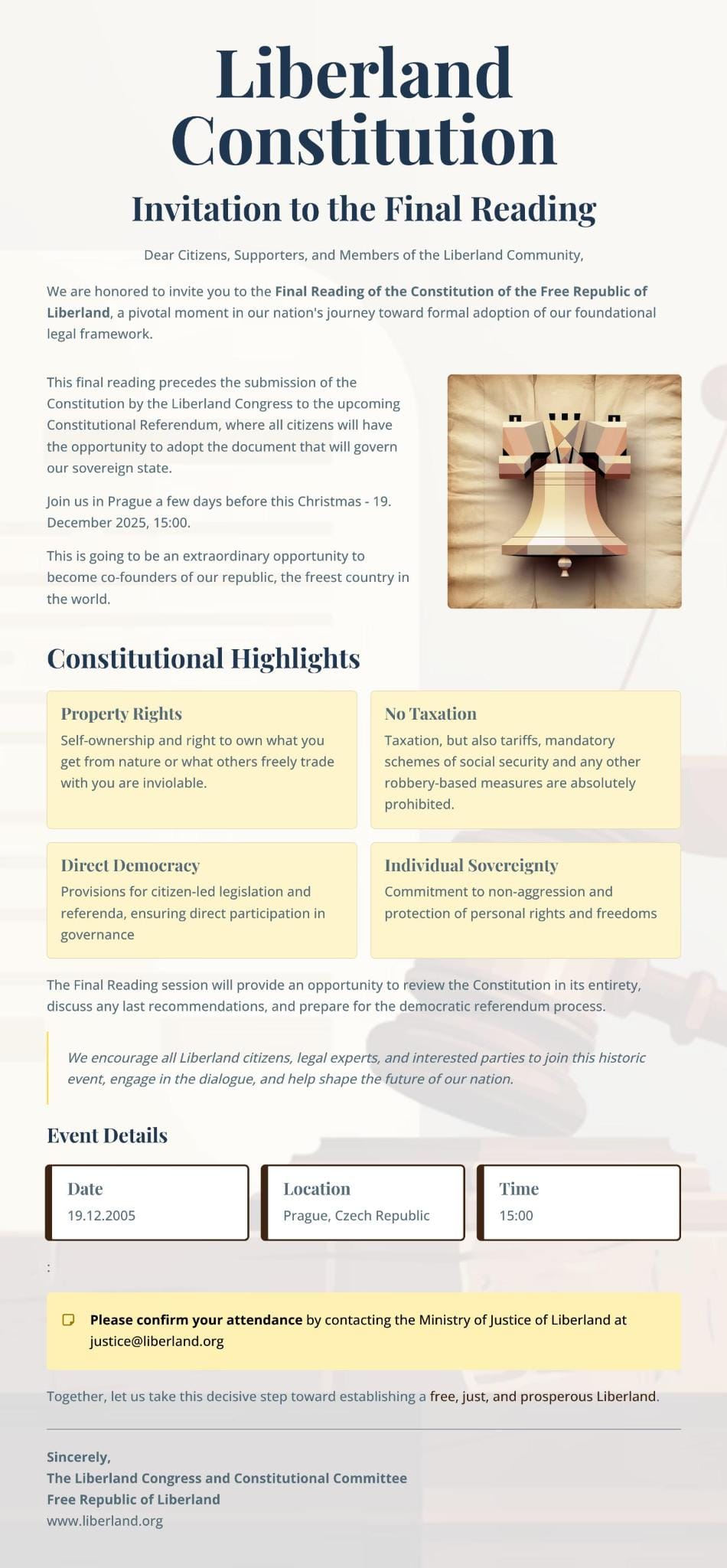 As noted in Liberland Constitution Christmas Party Prague 2025, despite my frequent criticisms of libertarian activists and activism over the years, and despite my preference for the theoretical side of things, I’ve been involved in various activist projects for over the years, including helping to draft early versions of the Liberland Constitution. 1 I’ve met Liberland’s President, Vít Jedlička, and previous meetings of the Property and Freedom Society. At this year’s PFS meeting, he invited me, Alessandro Fusillo, and Hans-Hermann Hoppe to the Liberland meeting in Prague this December. We did attend. It was a marvelous event.
Related:
- My Failed Libertarian Speaking Hiatus; Memories of Mises Institute and Other Events, 1988–
20192025 - KOL345 | Kinsella’s Libertarian “Constitution” or: State Constitutions vs. the Libertarian Private Law Code (PorcFest 2021)
- KOL359 | State Constitutions vs. the Libertarian Private Law Code (PFS 2021)
The Liberland Constitution and Libertarian Principles
Stephan Kinsella[*]
Remarks prepared for the Liberland Christmas Party and Constitutional Reading, Prague, Dec. 19, 2025
[Published as Stephan Kinsella, “The Liberland Constitution and Libertarian Principles,” Libertarian Alliance (UK) (26 December, 2025)]
I would like to discuss the issue of “constitutions” and states, and their relation to human freedom.
I. Man, Action, and Freedom
A. Acting Man
A free society has long been the aspiration and dream of liberals of all types, including modern libertarians.[2]
What exactly is freedom? To understand this we must understand the nature of human action in the world.
Man finds himself in a world of scarcity and hardship, where nothing is guaranteed to him—neither food, nor shelter, nor safety, nor survival. Acting man is aware of his present state and the world around him, of the receding past, and the coming future. He lives in the present, always moving from the immediate past into the coming future. He constantly faces uneasiness in his present condition and about the future anticipates is coming. He is neither omnipotent nor omniscient, as implied by the existence of scarcity and uneasiness, and yet he can act: he can acquire knowledge: he can learn what ends are possible and what scarce means (resources) can cause things to happen. He can use his body, which he directly controls, and he can acquire and possess and use resources in the world by grappling with them using his body, to make things happen—to give rise to a different future than the one he foresees will arrive without his intervention.[3] Knowledge about the world—about causal laws, recipes, facts about the world and his environment, about possible ends he could choose and possible means he could employ—and the availability and employment of causally efficacious resources together make successful human action possible.[4] It makes possible the achievement of ends and the alleviation of felt uneasiness. By using one’s mind and body it is possible to succeed, to achieve what Mises would term psychic proft.[5]
B. Acting Man in Isolation
For Crusoe on his island what concerns acting man is causal and technical knowledge, and knowledge about contingent facts in his world—and the availability of means of action. For him he may face wild animals, injury, lightning and storms and drought and disease, and any number of challenges, but the concept of freedom does not arise. There is only successful action, or profit, and life; and loss and failure, and death.
C. Acting Man in Society
With the presence of other people man, the social animal, can benefit from the comforts of society, from collective cooperation, from intercourse and trade, from the division and specialization of labor. But there is also the possibility of violent conflict over the use of the scarce means of action that are essential for successful human action. Other people are a potential benefit but also a potential threat. Perhaps because men are social animals have some empathy for others, and perhaps because they understand that violence is not productive, they prefer peaceful and productive use of resources, trade, and cooperation to violence, conflict, and strife.[6] Thus there tends to emerge in society the institution of property rights: widespread social respect for and mutual recognition of property rights rooted in original appropriation and contractual title transfer.[7]
Unfortunately, this tends to give rise to an agency—the state—that claims the right to tax and to ultimate decision-making and law-making. As Hoppe notes,
Let me begin with the definition of a state. What must an agent be able to do to qualify as a state? This agent must be able to insist that all conflicts among the inhabitants of a given territory be brought to him for ultimate decision-making or be subject to his final review. In particular, this agent must be able to insist that all conflicts involving himself be adjudicated by him or his agent. And implied in the power to exclude all others from acting as ultimate judge, as the second defining characteristic of a state, is the agent’s power to tax: to unilaterally determine the price that justice seekers must pay for his services.
Based on this definition of a state, it is easy to understand why a desire to control a state might exist. For whoever is a monopolist of final arbitration within a given territory can make laws. And he who can legislate can also tax. Surely, this is an enviable position.[8]
The purpose of property rights, of justice, is to permit men to use their own bodies and peacefully acquired (meaning: acquired by original appropriation, which violates no one’s rights as the resource is unowned; or by consensual contractual transfer from a previous owner, which also violates no one’s rights as the owner consents to the transfer) scarce means without conflict from others. It is so that men are free to use their own bodies or resources without interference from others.
II. Freedom in Society
Thus terms like freedom and liberty denote a state of affairs where acting man is free to use his body and other scarce resources in the world without physical interference by others—without conflict. It refers to a world where men are free from interference by private trespassers and also free from institutionalized interference by a state. Freedom and liberty just mean the absence of aggression with private property rights.
Ideally, a free society means having either no state at all or a minimal state (minarchy) restricted to preventing aggression defined in terms of property rights,[9] and in a society with a largely libertarian ethos and minimal private crime. In such a society there is widespread liberty because there is little private crime and little to no institutionalize crime.
A. Freedom and State Aggression
But we live in a world governed by non-minimal states. They control most habitable territory on the earth. They compel membership and payment of taxes and monopolize their services, outlawing competitors. By legislative decree, these states prohibit not only acts that are malum in se but acts that are merely malum prohibitum. Although the justification for the agency that polices crime is to reduce aggression by private trespassers, with the state there is more private crime than there would be otherwise, because states are necessarily inefficient an also because they criminalize non-criminal actions.[10] All states are, in fact, criminal (and even minimal states would be criminal, even if they managed to ever emerge); all states engage in institutionalized aggression against private property rights. As Hoppe notes:
socialism, by no means an invention of nineteenth century Marxism but much older, must be conceptualized as an institutionalized interference with or aggression against private property and private property claims. Capitalism, on the other hand, is a social system based on the explicit recognition of private property and of nonaggressive, contractual exchanges between private property owners. Implied in this remark, as will become clear in the course of this treatise, is the belief that there must then exist varying types and degrees of socialism and capitalism, i.e., varying degrees to which private property rights are respected or ignored. Societies are not simply capitalist or socialist. Indeed, all existing societies are socialist to some extent.
… Next to the concept of action, property is the most basic category in the social sciences. As a matter of fact, all other concepts to be introduced in this chapter—aggression, contract, capitalism and socialism—are definable in terms of property: aggression being aggression against property, contract being a nonaggressive relationship between property owners, socialism being an institutionalized policy of aggression against property, and capitalism being an institutionalized policy of the recognition of property and contractualism.
… the question regarding the socio-psychological foundations of socialism is identical to that of the foundations of a state, if there were no institution enforcing socialistic ideas of property, there would be no room for a state, as a state is nothing else than an institution built on taxation and unsolicited, noncontractual interference with the use that private people can make of their natural property. There can be no socialism without a state, and as long as there is a state there is socialism. The state, then, is the very institution that puts socialism into action; and as socialism rests on aggressive violence directed against innocent victims, aggressive violence is the nature of any state.”[11]
B. Constitutional Limitations on State Power
Because of the obvious danger of state power and well-known state abuses of rights throughout history, even among those who believe the state is necessary and does reduce private crime, there is widespread support for limitations on state power, such as those found in the US Bill of Rights and other structures and methods such as federalism/decentralism.[12] Classical liberals and minarchists aspire to a state restricted to its core functions of reducing private crime but with “constitutional” limits to prevent it from becoming tyrannical and a greater threat to rights and liberty than the private criminals the state purports to combat.
Libertarians and others have tried their hand at suggesting improvements to existing state constitutions or laws. I suggested some improvements to various draft laws and constitutions for various eastern-bloc countries after the fall of Soviet communism in the early 1990s, or example.[13] Ayn Rand apparently believed, contra factum, that the original US constitutional system was very close to minarchist perfection. Witness the scene near the end of Atlas Shrugged (1957), where wise judge Narragansett
sat at a table, and the light of his lamp fell on the copy of an ancient document. He had marked and crossed out the contradictions in its statements that had once been the cause of its destruction. He was now adding a new clause to its pages: “Congress shall make no law abridging the freedom of production and trade … ”
None of the techniques suggested by minarchists or classical liberals have ever come close to producing a minimal state, but they keep the state from becoming more tyrannical than it otherwise would be. In truth, all states are limited; no state is truly unlimited. Thus the concept of “limited government” is somewhat of a misnomer, even if the goal behind this notion is well intentioned.
In any case, despite the lack of historical evidence that any minimal state has ever existed and theoretical reasons to believe this is an impossible pipedream, advocates of liberty sometimes suggest more ideal constitutions for minarchist or even anarchist societies.[14] Perhaps this is the triumph of hope over experience. In any case, a truly minarchist state has yet to be achieved and does not seem at all likely anytime soon.
Before I turn my attention to the issue of libertarian constitutions, let me first mention some other responses to the problem of statism.
C. Escaping or Evading State Aggression
In addition to engaging in various forms of activism in an attempt to reduce the scope of state power or impose limits and restrictions on the state, others seek liberty in other ways. Some seek wealth and power within a statist-system to preserve their liberty.[15] Others seek various forms of exit such as emigration to freer jurisdictions.
D. Creating Oases of Liberty
Still others attempt to carve out relative oases or enclaves of liberty within existing states, such as Próspera, a charter city on the island of Roatán, Honduras; the Dubai International Financial Centre (DIFC), a special economic zone in Dubai adopting common law; and so on.[16] Many of these projects are now clustered around the Free Cities Foundation (https://free-cities.org/). Some such projects have been disasters or scams.[17]
E. Creating New Countries
Others seek more radical solutions, such as stateless or minarchist projects like seasteading or attempts to form new countries or states.[18]
III. Written Constitutions and Freedom
A. Minarchist Constitutions
It is often taken for granted by libertarians, even many anarchist libertarians, that just as modern states are said to have constitutions, this would naturally be the case in a minarchist state and even in the case of an anarchist libertarian society (call it anarcho-capitalist, the private-law society, what have you). They simply think that the constitution should be libertarian in substance, but certainly a “constitution” of some type.
Ayn Rand and Objectivists, for example, certainly envision something like an American-style written constitution governing the minimal government, a night-watchman style state, of a free society, if not the entire world.[19] Others have proposed draft constitutions even for anarchy (see note 13, above). I was myself involved in earlier attempts to draft Liberland’s constitution back in 2017.[20] Even Rothbard mused about the need for a “libertarian law code.” As he wrote in The Ethics of Liberty:
While the book establishes the general outlines of a system of libertarian law, however, it is only an outline, a prolegomenon to what I hope will be a fully developed libertarian law code of the future. Hopefully, libertarian jurists and legal theorists will arise to hammer out the system of libertarian law in detail, for such a law code will be necessary to the truly successful functioning of what we may hope will be the libertarian society of the future.[21]
And:
there exists another alternative for law in society, an alternative not only to administrative decree or statutory legislation, but even to judge-made law. That alternative is the libertarian law, based on the criterion that violence may only be used against those who initiate violence, and based therefore on the inviolability of the person and property of every individual from “invasion” by violence. In practice, this means taking the largely libertarian common law, and correcting it by the use of man’s reason, before enshrining it as a permanently fixed libertarian code or constitution. And it means the continual interpretation and application of this libertarian law code by experts and judges in privately competitive courts.[22]
Here Rothbard seems to contemplate a comprehensive, written law code or constitution, with the details “hammered out” before it is “permanently fixed” and “enshrined.” This sure seems like a legislated, written constitution.
B. Problems with Constitutions
1. Mini-Statism
Now there are many problems with such “constitutions.” One is that most constitutions are constitutions of states—and never minimal states either. All states have wide powers the violate rights—usually so-called “plenary” legislative and police power, even in the case of the US federal with so-called limited and enumerated power.[23] The purpose of constitutions is not to limit powers to but legitimize a state and its right to assert power—to create, or makeup, or “constitute,” a new state, as the 13 American States did when they ratified the US Constitution, thereby creating a new state with certain powers granted in the US Constitution. Its purpose is to grant power, not limit it.[24]
2. A Judge in Its Own Case
It well known principle of private law that “being a judge in one’s own case” is to be avoided where possible—nemo iudex in causa sua[25]—because of the danger of impartiality, the risk of overpunishment, lack of due process, and so on. For this reason self-help is to be avoided, and self defense is permitted only in narrowly defined circumstances.[26] Yet the supposed constitutional limits on state power are interpreted by the state itself. As Rothbard and Hoppe point out, because the state controls law and the legal system and the courts are its own courts, constitutional limits on the state’s power somewhat meaningless. This truth is somewhat obscured by the fiction that the courts are “independent” and a “different political branch” tasked with nullifying unconstitutional actions by the state’s executive branch. But of course the courts are part of the state itself.
As Rothbard points out,
a Constitution will not be able to keep the government limited; for given a monopoly Supreme Court selected by the self-same government and granted the power of ultimate decision- making, the political “ins” will always favor a “broad” or loose interpretation of the wording of the Constitution serving to expand the powers of government over the citizenry; and, over time, the “ins” will inexorably tend to win out over the minority of “outs” who will argue vainly for a “strict” interpretation limiting State power.[27]
And as Hoppe notes in his introductory essay to The Ethics of Liberty:
Based on this analysis, Rothbard considered the classical-liberal solution to the fundamental human problem of protection—of a minimal or night-watchman state, or an otherwise “constitutionally limited” government—as a hopelessly confused and naive idea. Every minimal state has the inherent tendency to become a maximal state, for once an agency is permitted to collect any taxes, however small and for whatever purpose, it will naturally tend to employ its current tax revenue for the collection of ever more future taxes for the same and/or other purposes. Similarly, once an agency possesses any judiciary monopoly, it will naturally tend to employ this privileged position for the further expansion of its range of jurisdiction. Constitutions, after all, are state-constitutions, and whatever limitations they may contain—what is or is not constitutional—is determined by state courts and judges. Hence, there is no other possible way of limiting state power except by eliminating the state altogether and, in accordance with justice and economics, establishing a free market in protection and security services.[28]
Thus, as Spooner concludes in his evisceration of the US Constitution,
whether the Constitution really be one thing, or another, this much is certain — that it has either authorized such a government as we have had, or has been powerless to prevent it. In either case, it is unfit to exist.[29]
3. Legal Positivism and Legislation
In addition, the very idea that must be a written constitution ignores the fact that there are and can be unwritten constitutions, such as the English or UK Constitution.[30] The fact that this assumption is so widespread is a result of the rise of legal positivism.[31] Today people think of contracts as some signed written document, rather than as merely evidence of the terms of a mutual agreement between the parties.[32] Similarly, while law used to be thought of in terms of immutable principles of justice, because of the rise of legislation and legal and legislative positivism, law is thought of as some written statute decreed by the state.[33] Thus, for example, when an income tax protestors is told that it is a crime to evade income tax, they response is “show me the law,” meaning “show me the statute,” since law is now thought of as written decrees by the legislature.
Moreover, law develops in an incremental, organic fashion, by judges or arbitrators hearing disputes between actual parties, in an attempt to do justice and based on universally accepted grundnorms such as peace, self-ownership, original appropriation, contract.[34]
IV. The Liberland Constitution
For all these reasons, the concept of a constitution is problematic. First, the primary purpose is to authorize a state; even if minarchist, all states are unjust because they outlaw competitors and tax. And all existing constitutions serve to legitimize non-minarchist states. Second, constitutions are often too detailed. A libertarian law code cannot be deduced from first principles; it must develop organically over time in thousands of cases.
Thus, a libertarian constitution needs to set out the basic principles of justice within which private law can organically develop over time, and these principles need to clearly define property rights in actors’ bodies and in external resources acquired by original appropriation or contract and to make it clear that aggression against justly owned resources is impermissible.
It is for these reasons that a group of us recently worked on such a project, The Universal Principles of Liberty (UPL), finalized and adopted on August 14, 2025.[35] The UPL is not a constitution exactly, since it does not authorize a state, nor is it a detailed legal code, as that task is premature at this point and beyond the scope of a concise and coherent statement of principles. It is our hope that future societies might adopt and build free societies based on the UPL.
Where does that leave the Liberland Constitution? First, it is to be noted that Liberland seeks to gain recognition of others states of the world, which requires various attributes of sovereignty: (a) a permanent population; (b) a defined territory; (c) government; and (d) capacity to enter into relations with the other states.[36] And yet the draft Liberland Constitution[37] explicitly forbids taxation:
[§2.2] Neither the State nor any institution, office, or initiative thereof shall derive revenue through theft, coercion, or any act equivalent thereto. Accordingly, no compelled taxation, tariff, toll, or mandatory social contribution shall be imposed upon any person under the jurisdiction of this Constitution.
I have also suggested incorporating the UPL by reference into the Liberland Constitution, to the extent that the UPL is not inconsistent with terms of the Liberland Constitution, by this language:
[§1.3] The Universal Principles of Liberty, adopted on 14 August 2025 and as they stand on the date of adoption of this Constitution, are hereby incorporated by reference and may be consulted for interpretive and suppletive purposes, to the extent that they are not incompatible with the provisions of this Constitution.
A society based on the Liberland Constitution would be one that is off to a good start.
[Endnotes; some formatting missing]
[*] Stephan Kinsella (www.StephanKinsella.com) is an intellectual property attorney and libertarian writer in Houston. He is the author of numerous publications including Legal Foundations of a Free Society (Papinian Press, 2023; https://stephankinsella.com/lffs/; hereinafter LFFS); The Universal Principles of Liberty (2025; https://stephankinsella.com/principles/; hereinafter Principles); International Investment, Political Risk, and Dispute Resolution (Oxford University Press, 2020; https://kinsellalaw.com/iipr/); and Against Intellectual Property (Mises Institute, 2001; https://c4sif.org/aip/).
[2] The modern libertarian movement is about 50–70 years old. See Stephan Kinsella, “Libertarianism After Fifty Years: What Have We Learned?,” in LFFS.
[3] See Stephan Kinsella, “Human Action and Universe Creation,” StephanKinsella.com (June 28, 2022; https://stephankinsella.com/2022/06/human-action-and-universe-creation/); see generally Ludwig von Mises, Human Action: A Treatise on Economics, Scholar’s ed. (Auburn, Ala: Mises Institute, 1998; https://mises.org/library/human-action-0), chs. 1, 4, et pass.; Murray N. Rothbard, Man, Economy, and State, with Power and Market, Scholars ed., 2d ed. (Auburn, Ala.: Mises Institute, 2009; https://mises.org/library/man-economyand-state-power-and-market), ch. 1 et pass..
[4] See Stephan Kinsella, “Libertarian and Lockean Creationism: Creation As a Source of Wealth, not Property Rights; Hayek’s “Fund of Experience”; the Distinction Between Scarce Means and Knowledge as Guides to Action,” C4SIF Blog (May 6, 2025; https://c4sif.org/2025/05/libertarian-lockean-creationism/).
[5] Mises, Human Action, ch. 15, §8, pp. 286–287; Rothbard, Man, Economy, and State, with Power and Market, ch. 1, §2 et pass.
[6] See Stephan Kinsella, “What Libertarianism Is,” in LFFS, n.22, text at n. 40; idem, “The Division of Labor as the Source of Grundnorms and Rights,” Mises Economics Blog (April 24, 2009; https://stephankinsella.com/2009/04/the-division-of-labor-as-the-source-of-grundnorms-and-rights/), and idem, “Empathy and the Source of Rights,” Mises Economics Blog (Sept. 6, 2006; https://stephankinsella.com/2006/09/empathy-and-the-source-of-rights/).
[7] See Stephan Kinsella, “On Property Rights in Superabundant Bananas and Property Rights as Normative Support for Possession,” StephanKinsella.com (April 19, 2025; https://stephankinsella.com/2025/04/superabundant-bananas-property-rights-normative-support/).
[8] Hans-Hermann Hoppe, “The Role of Intellectuals and Anti-intellectual Intellectuals,” in The Great Fiction: Property, Economy, Society, and the Politics of Decline, Second Expanded Edition (Mises Institute, 2021). See also Stephan Kinsella, “The Nature of the State and Why Libertarians Hate It,” StephanKinsella.com (May 3, 2010; https://stephankinsella.com/2010/05/the-nature-of-the-state-and-why-libertarians-hate-it/).
[9] Though there is some debate about terminology and classifications, in my view the term libertarian is broad enough to encompass both minarchist and anarchist libertarians, but not classical liberals, which are better seen as our forebears. Stephan Kinsella, “Rothbard on Leonard Read and the Origins of ‘Libertarianism,”” StephanKinsella.com (Nov. 17, 2014; https://stephankinsella.com/2014/11/the-origin-of-libertarianism/); idem, “The Origin of ‘Libertarian,’” Mises Economics Blog (Sep. 10, 2011; https://stephankinsella.com/2011/09/the-origin-of-libertarian/). We anarchist libertarians view minarchists are inconsistent libertarians, or mini-statists, since they do not consistently oppose all forms of aggression, to-wit the institutionalized aggression necessarily committed by the state. See idem, “What Libertarianism Is” and “What It Means To Be an Anarcho-Capitalist,” both in LFFS.
[10] See Kinsella, “Legislation and the Discovery of Law in a Free Society,” in LFFS, Part III.B.4 and III.D (on negative social effects of legislation, uncertainty, and the proliferation of artificial, malum prohibitum legislation.
[11] Hans-Hermann Hoppe, A Theory of Socialism and Capitalism (Laissez Faire Books, 2013; https://hanshoppe.com/tsc/), chs. 1, 2 and 8; bold emphasis added.
[12] See Stephan Kinsella, “Structural Safeguards to Limit Legislation and State Power,” StephanKinsella.com (Jan. 23, 2015); “Constitutional Structures in Defense of Freedom (ASC 1998),” StephanKinsella.com (June 25, 2021); “Randy Barnett’s “Federalism Amendment”–A Counterproposal; and related posts,” StephanKinsella.com (Dec. 3, 2010); “KOL345 | Kinsella’s Libertarian “Constitution” or: State Constitutions vs. the Libertarian Private Law Code (PorcFest 2021),” Kinsella on Liberty Podcast (June 26, 2021); “KOL359 | State Constitutions vs. the Libertarian Private Law Code (PFS 2021),” Kinsella on Liberty Podcast (Oct. 11, 2021), all available at www.stephankinsella.com.
[13] Kinsella, “Comments on Draft Law on Stimulation of Foreign Investments in Romania,” for ABA/CEELI (Spring 1997); “Comments on Draft Law on Foreign Investment Activities in Nizhny Novgorod Oblast (Russia)”; “Comments on Draft Project of “Law on Foreign Capital Investment in the Republic of Lithuania, Memorandum to Mr. M. Černiauskas, President, Association of Lithuanian Chambers of Commerce and Industry” (November 18 1993); “Lithuania’s Proposed Foreign Investment Laws: A Free-Market Critique,” Russian Oil & Gas Guide (Vol. 3, No. 2, April 1994); “The Russian Constitution of 1993–Provisions of Interest to the Energy Industry,” Russian Oil & Gas Guide (Vol. 4, No. 2, April 1995), all available at idem, “Using International Law to Protect Property Rights and International Investment,” StephanKinsella.com (Nov. 24, 2025; https://stephankinsella.com/2025/11/international-law-protect-property-rights/).
[14] See Tom W. Bell, “Ulex,” the “Open Source Legal Operating System” (https://perma.cc/L5J7-FCXN); Ilya Shapiro, Tim Sandefur, and Christina Mulligan, “The Libertarian Constitution,” National Constitution Center (https://perma.cc/F9P5-839L). For more anarchist attempts, see various articles in formulations, available at the Free Nation Foundation Archive of Publications (http://freenation.org/a/), such as Roderick T. Long, “Imagineering Freedom: A Constitution of Liberty” (Summer 1994, Winter 1994-95, Spring 1995, Summer 1995), Michael Darby, “Draft Constitution for a Reviving or New Nation” (Autumn 1998), and several pieces in the October 1993 issue: Richard O. Hammer, “The Basics of Constitutions”; Bobby Yates Emory, “The Articles of Confederation”; Roderick T. Long, The Rationale of a Virtual-Canton Constitution and “Draft of a Virtual-Canton Constitution: Version 4”; Eric Klien and Mike Oliver, “The Constitution of Oceania: Draft 0.80”; and Richard Hammer, Bobby Emory and Roderick Long, “Analysis of the Constitution of Oceania.” For non-minarchist, more classical-liberal inspired visions for limited government, see Bernard H. Siegen, Drafting a Constitution for a Nation or Republic Emerging into Freedom 2d ed. (Fairfax, Virginia: George Mason University Press, 1994); Prince Hans-Adam, The State in the Third Millennium (2009; pdf); Stephan Kinsella, “‘A draft constitution for the state in the third millennium,’ by Prince Hans-Adam of Liechtenstein,” StephanKinsella.com (Aug. 25, 2025; https://stephankinsella.com/2025/08/draft-constitution-hans-adam-liechtenstein/).
[15] Stephan Kinsella, “Make Money to Buy Your Freedom,” StephanKinsella.com (May 30, 2025; https://stephankinsella.com/2025/05/make-money-to-buy-your-freedom/).
[16] Others include Veritas Villages (https://www.veritasvillages.com/), freedom-oriented communities in Nicaragua, Panama and (soon, according to the site) Costa Rica.
[17] Such as Galt’s Gulch Chile. See Harry Cheadle, “Atlas Mugged: How a Libertarian Paradise in Chile Fell Apart,” Vice (Sep. 22, 2014; https://perma.cc/NEF9-LL9W); Wendy McElroy, “The Fate of Galt’s Gulch Chile,” The Daily Bell (Aug. 25, 2014; https://perma.cc/LR92-XSNW); Dagney Taggart, “Galt’s Gulch Chile Con Man’s Go-To Tactic—Projection,” GGC Recovery (Sep. 1, 2016; https://perma.cc/HZW4-38TU).
[18] See The Seasteading Institute (https://www.seasteading.org/); Joe Quirk and Patri Friedman, Seasteading: How Floating Nations Will Restore the Environment, Enrich the Poor, Cure the Sick, and Liberate Humanity from Politicians (Free Press, 2018; https://www.amazon.com/Seasteading-Floating-Environment-Liberate-Politicians/dp/1451699271); also Oceania—The Atlantis Project (https://oceania.org/); the Lifeboat Foundation (https://web.archive.org/web/20020325155023/http://www.lifeboat.com/); “michael,” “An Interstellar Lifeboat for Humanity,” Slashdot (Nov. 21, 2002; https://science.slashdot.org/story/02/11/21/1453253/an-interstellar-lifeboat-for-humanity).
[19] Stephan Kinsella, “Rand, Objectivism, and One-World Government,”StephanKinsella.com (Sep. 17, 2009; https://stephankinsella.com/2009/09/rand-objectivism-and-one-world-government/); idem, “Objectivism, Bidinotto, and Anarchy,” StephanKinsella.com (Sep. 17, 2009; https://stephankinsella.com/2009/09/objectivism-bidinotto-and-anarchy/).
[20] Trey Goff, Stephan Kinsella, Cesar Balmeseda, and Pierre-Louis Boitel, “The Voluntaryist Constitution,” Mises Wire (Oct. 24, 2017; https://stephankinsella.com/2017/10/the-voluntaryist-constitution/).
[21] Murray N. Rothbard, “Preface,” in The Ethics of Liberty (New York: New York University Press, 1998; https://stephankinsella.com/2022/12/rothbard-the-ethics-of-liberty/), pp. xlviii–xlix (bold emphasis added).
[22] Murray N. Rothbard, “How To Have Law Without Legislation,” Mises Daily (July 05, 2014; https://mises.org/mises-daily/how-have-law-without-legislation) (bold emphasis added). See also Kinsella, “Legislation and the Discovery of Law in a Free Society,” Part IV.B; idem, “On the Role of Commentators and Codes and the Oracles of the Law,” StephanKinsella.com (July 31, 2025; https://stephankinsella.com/2025/07/commentators-codes/).
[23] Stephan Kinsella, “The Unique American Federal Government,” StephanKinsella.com (Oct. 26, 2009; https://stephankinsella.com/2009/10/the-unique-american-federal-government/).
[24] Stephan Kinsella, “Rockwell on Hoppe on the Constitution as Expansion of Government Power,” StephanKinsella.com (Aug. 3, 2009; https://stephankinsella.com/2009/08/rockwell-on-hoppe-on-the-constitution-as-expansion-of-government-power/).
[25] “Nemo iudex in causa sua” (Wikpedia; https://en.wikipedia.org/wiki/Nemo_iudex_in_causa_sua).
[26] “Self-help (law)” (Wikipedia; https://en.wikipedia.org/wiki/Self-help_(law)); “Right of self-defense” (Wikipedia; https://en.wikipedia.org/wiki/Right_of_self-defense).
[27] Rothbard, “The Inner Contradictions of the State,” in The Ethics of Liberty, pp. 177–178 (https://mises.org/mises-daily/state-versus-liberty).
[28] Hans-Hermann Hoppe, “Introduction,” in Rothbard, The Ethics of Liberty, p. xxi (https://hanshoppe.com/2014/12/murray-n-rothbard-and-the-ethics-of-liberty/). See also Stephan Kinsella, “The Power to Tax and the Power to Outlaw Competition Imply Each Other,” StephanKinsella.com (July 12, 2025; https://stephankinsella.com/2025/07/the-power-to-tax-power-to-outlaw-competition/). The state’s appointment of itself as ultimate judge, and its power to decide whether and when the law—the state‘s law—applies to itself, violates the very notion of justice, since the state judges itself but a different standard of justice than that which applies to its subjects. See Stephan Kinsella, “Bastiat: Actions That Are Unjust for Individuals Are Unjust for Agencies and Groups,” StephanKinsella.com (Dec. 24, 2025).
[29] Lysander Spooner, No Treason. No. VI. The Constitution of No Authority (1870; https://oll.libertyfund.org/titles/spooner-no-treason-no-vi-the-constitution-of-no-authority-1870).
[30] “Constitution of the United Kingdom” (Wikipedia; https://en.wikipedia.org/wiki/Constitution_of_the_United_Kingdom).
[31] Stephan Kinsella, “Legislation and the Discovery of Law in a Free Society,” in LFFS; idem, “Legislative Positivism and Rationalism in the Louisiana and French Civil Codes,” StephanKinsella.com (April 6, 2023, https://stephankinsella.com/2023/04/legislative-positivism-and-rationalism-in-the-louisiana-and-french-civil-codes/); idem, “On ‘Unowned’ State Property, Legal Positivism, Ownership vs. Possession, Immigration, Public Roads, and the Bum in the Library,” StephanKinsella.com (May 26, 2025; https://stephankinsella.com/2025/05/unowned-state-property-legal-positivism-immigration/); idem, “Logical and Legal Positivism,” StephanKinsella.com (June 23, 2010; https://stephankinsella.com/2010/06/logical-and-legal-positivism/); idem, “The Mountain of IP Legislation,” C4SIF Blog (Nov. 24, 2010; https://c4sif.org/2010/11/the-mountain-of-ip-legislation/).
[32] Stephan Kinsella, “The Libertarian View on Fine Print, Shrinkwrap, Clickwrap,” StephanKinsella.com (May 8, 2009; https://stephankinsella.com/2009/05/the-libertarian-view-on-fine-print-shrinkwrap-clickwrap/); idem, “The Title-Transfer Theory of Contract,” in David Howden, ed., Palgrave Handbook of Misesian Austrian Economics (Palgrave, forthcoming; https://stephankinsella.com/2024/09/tttc-wp-1/).
[33] See Stephan Kinsella, “KOL474 | Where The Common Law Goes Wrong (PFS 2025),” Kinsella on Liberty Podcast (Sep. 19, 2025; https://stephankinsella.com/as_paf_podcast/kol474-where-the-common-law-goes-wrong-pfs-2025/); idem, “Another Problem with Legislation: James Carter v. the Field Codes,” StephanKinsella.com (Oct. 14, 2009; https://stephankinsella.com/2009/10/another-problem-with-legislation-james-carter-v-the-field-codes/); idem, “On ‘Unowned’ State Property, Legal Positivism, Ownership vs. Possession, Immigration, Public Roads, and the Bum in the Library”; idem, “Logical and Legal Positivism.”
[34] See Kinsella, “Legislation and the Discovery of Law in a Free Society,” Part V.B; “Legislation and the Discovery of Law in a Free Society”; idem, “On the Role of Commentators and Codes and the Oracles of the Law”; idem, “Roman Law and Hypothetical Cases,” StephanKinsella.com (Dec. 19, 2022; https://stephankinsella.com/2022/12/roman-law-and-hypothetical-cases/); idem, “On Pushing the Button–the problem with magic,” StephanKinsella.com (Nov. 3, 2009; https://stephankinsella.com/2009/11/on-pushing-the-button-the-problem-with-magic/); idem, “The Limits of Armchair Theorizing: The Case of Threats,” StephanKinsella.com (July 27, 2006; https://stephankinsella.com/2006/07/the-limits-of-armchair-theorizing-the-case-of-threats/).
[35] The Universal Principles of Liberty (Aug. 14, 2025; https://stephankinsella.com/principles/).
[36] See Montevideo Convention on the Rights and Duties of States (Wikipedia; December 26, 1933; https://en.wikipedia.org/wiki/Montevideo_Convention), Art. 1; American Law Institute, Restatement (Third) of the Foreign Relations Law of the United States (1987), §201; James Crawford, Brownlie’s Principles of Public International Law 9th ed. (Oxford, 2019), p.117 ch. 5, §2; Malcolm N. Shaw, International Law 9th ed. (Cambridge, 2021), ch. 5, section “Creation of Statehood”; James Crawford, The Creation of States in International Law 2d ed. (Oxford 2006), §2.2; Jorri C. Duursma, Fragmentation and the International Relations of Micro-states: Self-determination and Statehood (Cambridge Studies in International and Comparative Law, Series Number 2; Cambridge, 1996); “Sovereign state” (Wikipedia; https://en.wikipedia.org/wiki/Sovereign_state). Liberland’s President, Vít Jedlička (https://en.wikipedia.org/wiki/V%C3%ADt_Jedli%C4%8Dka), at the Dec. 19 event, explained that there are a number of current residents living on the territory of Liberland. See the Liberland FAQ at https://liberland.org/faq: “Is Liberland an actual country? Yes, Liberland has a government, a population, a defined territory, and diplomatic relations with other states.” Whether these settlers would count under international law. See Shaw, International Law, ch. 5 (“The existence of a permanent population[15] is naturally required and there is no specification of a minimum number of inhabitants, as examples such as Nauru and Tuvalu[16] demonstrate. … [15] A nomadic population might not thus count for the purposes of territorial sovereignty, although the International Court in Western Sahara, ICJ Reports, 1975, pp. 12, 63–5; 59 ILR, pp. 30, 80–2, held that nomadic peoples did have certain rights with regard to the land they traversed.”); Crawford, The Creation of States in International Law, §2.2(2): “If States are territorial entities, they are also aggregates of individuals. A permanent population is thus necessary for statehood, though, as in the case of territory, no minimum limit is apparently prescribed.” The smallest current state in terms of population is Vatican City, at 882. See Vatican City (Wikipedia; https://en.wikipedia.org/wiki/Vatican_City; accessed Dec. 19, 2025).
In his talk, Alessandro Fusillo, “How To Tame a Monster – the Problem of Constitutionalism,” in First Constitutional Convention of the Free Republic of Liberland, Vít Jedlička, ed. (Dec. 19, 2025; forthcoming), Fusillo states that he does not regard Liberland as a true “state” since it does not have the power to tax. One should also keep in mind that “government” does not imply “state.” See Stephan Kinsella, “The State is not the government; we don’t own property; scarcity doesn’t mean rare; coercion is not aggression,” StephanKinsella.com (Dec. 19, 2022; https://stephankinsella.com/2022/12/the-state-is-not-the-government/). It would appear then, that, to its credit, Liberland is attempting to do the bare minimum to qualify for international recognition as a “state,” by having a “government,” but without having the power to tax, which is not required by the international law criteria for states, any more more than the permanent population criterion requires a minimum number of inhabitants. On the other hand, the power to legislate and monopolize law enforcement also implies the power to tax. This must be kept in mind as well. See Kinsella, “The Power to Tax and the Power to Outlaw Competition Imply Each Other.”
[37] See Liberland Constitution (https://liberland.org/constitution; text currently available at https://docs.google.com/document/d/1Wz2xkM15LNWVgX_Wm7cdUAGzZimhpHVYQFq80EhtuFg/edit?tab=t.0#heading=h.d5ub722kooe0).
***
Transcript (Apple/Grok):
[N.b.: the text is very close to the article above]
The Liberland Constitution and Libertarian Principles
Stephan Kinsella
Remarks prepared for the conference in Prague, Dec. 19, 2025
I would like to discuss the issue of “constitutions” and states, and their relation to human freedom.
I. Man, Action, and Freedom
A. Acting Man
A free society has long been the aspiration and dream of liberals of all types, including modern libertarians.
What exactly is freedom? To understand this we must understand the nature of human action in the world.
Man finds himself in a world of scarcity and hardship, where nothing is guaranteed to him—neither food, nor shelter, nor safety, nor survival.
Acting man is aware of his present state and the world around him, of the receding past, and the coming future.
He lives in the present, always moving from the immediate past into the coming future.
He constantly faces uneasiness in his present condition and about the future he anticipates is coming.
He is neither omnipotent nor omniscient, as implied by the existence of scarcity and uneasiness, and yet he can act: he can acquire knowledge; he can learn what ends are possible and what scarce means (resources) can cause things to happen.
He can use his body, which he directly controls, and he can acquire and possess and use resources in the world by grappling with them using his body, to make things happen—to give rise to a different future than the one he foresees will arrive without his intervention.
Knowledge about the world—about causal laws, recipes, facts about the world and his environment, about possible ends he could choose and possible means he could employ—and the availability and employment of causally efficacious resources together make successful human action possible.
It makes possible the achievement of ends and the alleviation of felt uneasiness.
By using one’s mind and body it is possible to succeed, to achieve what Mises would term psychic profit.
B. Acting Man in Isolation
For Crusoe on his island what concerns acting man is causal and technical knowledge, and knowledge about contingent facts in his world—and the availability of means of action.
For him he may face wild animals, injury, lightning and storms and drought and disease, and any number of challenges, but the concept of freedom does not arise.
There is only successful action, or profit, and life; and loss and failure, and death.
C. Acting Man in Society
With the presence of other people man, the social animal, can benefit from the comforts of society, from collective cooperation, from intercourse and trade, from the division and specialization of labor.
But there is also the possibility of violent conflict over the use of the scarce means of action that are essential for successful human action.
Other people are a potential benefit but also a potential threat.
Perhaps because men are social animals have some empathy for others, and perhaps because they understand that violence is not productive, they prefer peaceful and productive use of resources, trade, and cooperation to violence, conflict, and strife.
Thus there tends to emerge in society the institution of property rights: widespread social respect for and mutual recognition of property rights rooted in original appropriation and contractual title transfer.
Unfortunately, this tends to give rise to an agency—the state—that claims the right to tax and to ultimate decision-making and law-making.
As Hoppe notes,
Let me begin with the definition of a state. What must an agent be able to do to qualify as a state? This agent must be able to insist that all conflicts among the inhabitants of a given territory be brought to him for ultimate decision-making or be subject to his final review. In particular, this agent must be able to insist that all conflicts involving himself be adjudicated by him or his agent. And implied in the power to exclude all others from acting as ultimate judge, as the second defining characteristic of a state, is the agent’s power to tax: to unilaterally determine the price that justice seekers must pay for his services.
Based on this definition of a state, it is easy to understand why a desire to control a state might exist. For whoever is a monopolist of final arbitration within a given territory can make laws. And he who can legislate can also tax. Surely, this is an enviable position.
The purpose of property rights, of justice, is to permit men to use their own bodies and peacefully acquired (meaning: acquired by original appropriation, which violates no one’s rights as the resource is unowned; or by consensual contractual transfer from a previous owner, which also violates no one’s rights as the owner consents to the transfer) scarce means without conflict from others.
It is so that men are free to use their own bodies or resources without interference from others.
II. Freedom in Society
Thus terms like freedom and liberty denote a state of affairs where acting man is free to use his body and other scarce resources in the world without physical interference by others—without conflict.
It refers to a world where men are free from interference by private trespassers and also free from institutionalized interference by a state.
Freedom and liberty just mean the absence of aggression with private property rights.
Ideally, a free society means having either no state at all or a minimal state (minarchy) restricted to preventing aggression defined in terms of property rights, and in a society with a largely libertarian ethos and minimal private crime.
In such a society there is widespread liberty because there is little private crime and little to no institutionalized crime.
A. Freedom and State Aggression
But we live in a world governed by non-minimal states.
They control most habitable territory on the earth.
They compel membership and payment of taxes and monopolize their services, outlawing competitors.
By legislative decree, these states prohibit not only acts that are malum in se but acts that are merely malum prohibitum.
Although the justification for the agency that polices crime is to reduce aggression by private trespassers, with the state there is more private crime than there would be otherwise, because states are necessarily inefficient and also because they criminalize non-criminal actions.
All states are, in fact, criminal (and even minimal states would be criminal, even if they managed to ever emerge); all states engage in institutionalized aggression against private property rights.
As Hoppe notes:
socialism, by no means an invention of nineteenth century Marxism but much older, must be conceptualized as an institutionalized interference with or aggression against private property and private property claims. Capitalism, on the other hand, is a social system based on the explicit recognition of private property and of nonaggressive, contractual exchanges between private property owners. Implied in this remark, as will become clear in the course of this treatise, is the belief that there must then exist varying types and degrees of socialism and capitalism, i.e., varying degrees to which private property rights are respected or ignored. Societies are not simply capitalist or socialist. Indeed, all existing societies are socialist to some extent.
…Next to the concept of action, property is the most basic category in the social sciences. As a matter of fact, all other concepts to be introduced in this chapter—aggression, contract, capitalism and socialism—are definable in terms of property: aggression being aggression against property, contract being a nonaggressive relationship between property owners, socialism being an institutionalized policy of aggression against property, and capitalism being an institutionalized policy of the recognition of property and contractualism.
… the question regarding the socio-psychological foundations of socialism is identical to that of the foundations of a state, if there were no institution enforcing socialistic ideas of property, there would be no room for a state, as a state is nothing else than an institution built on taxation and unsolicited, noncontractual interference with the use that private people can make of their natural property. There can be no socialism without a state, and as long as there is a state there is socialism. The state, then, is the very institution that puts socialism into action; and as socialism rests on aggressive violence directed against innocent victims, aggressive violence is the nature of any state.
B. Constitutional Limitations on State Power
Because of the obvious danger of state power and well-known state abuses of rights throughout history, even among those who believe the state is necessary and does reduce private crime, there is widespread support for limitations on state power, such as those found in the US Bill of Rights and other structures and methods such as federalism/decentralism.
Classical liberals and minarchists aspire to a state restricted to its core functions of reducing private crime but with “constitutional” limits to prevent it from becoming tyrannical and a greater threat to rights and liberty than the private criminals the state purports to combat.
Libertarians and others have tried their hand at suggesting improvements to existing state constitutions or laws.
I suggested some improvements to various draft laws and constitutions for various eastern-bloc countries after the fall of Soviet communism in the early 1990s, for example.
Ayn Rand apparently believed, contra factum, that the original US constitutional system was very close to minarchist perfection.
Witness the scene near the end of Atlas Shrugged (1957), where wise judge Narragansett
sat at a table, and the light of his lamp fell on the copy of an ancient document. He had marked and crossed out the contradictions in its statements that had once been the cause of its destruction. He was now adding a new clause to its pages: “Congress shall make no law abridging the freedom of production and trade…”
None of the techniques suggested by minarchists or classical liberals have ever come close to producing a minimal state, but they keep the state from becoming more tyrannical than it otherwise would be.
In truth, all states are limited; no state is truly unlimited.
Thus the concept of “limited government” is somewhat of a misnomer, even if the goal behind this notion is well intentioned.
In any case, despite the lack of historical evidence that any minimal state has ever existed and theoretical reasons to believe this is an impossible pipedream, advocates of liberty sometimes suggest more ideal constitutions for minarchist or even anarchist societies.
Perhaps this is the triumph of hope over experience.
In any case, a truly minarchist state has yet to be achieved and does not seem at all likely anytime soon.
Before I turn my attention to the issue of libertarian constitutions, let me first mention some other responses to the problem of statism.
C. Escaping or Evading State Aggression
In addition to engaging in various forms of activism in an attempt to reduce the scope of state power or impose limits and restrictions on the state, others seek liberty in other ways.
Some seek wealth and power within a statist system to preserve their liberty.
Others seek various forms of exit such as emigration to freer jurisdictions.
D. Creating Oases of Liberty
Still others attempt to carve out relative oases or enclaves of liberty within existing states, such as Próspera, a charter city on the island of Roatán, Honduras; the Dubai International Financial Centre (DIFC), a special economic zone in Dubai adopting common law; and so on.
Many of these projects are now clustered around the network state/startup society/free cities movement.
Some such projects have been disasters or scams.
E. Creating New Countries
Others seek more radical solutions, such as stateless or minarchist projects like seasteading or attempts to form new countries or states.
III. Written Constitutions and Freedom
A. Minarchist Constitutions
It is often taken for granted by libertarians, even many anarchist libertarians, that just as modern states are said to have constitutions, this would naturally be the case in a minarchist state and even in the case of an anarchist libertarian society (call it anarcho-capitalist, the private-law society, what have you).
They simply think that the constitution should be libertarian in substance, but certainly a “constitution” of some type.
Ayn Rand and Objectivists, for example, certainly envision something like an American-style written constitution governing the minimal government, a night-watchman style state, of a free society, if not the entire world.
Others have proposed draft constitutions even for anarchy.
I was myself involved in earlier attempts to draft Liberland’s constitution back in 2017.
Even Rothbard mused about the need for a “libertarian law code.”
As he wrote in The Ethics of Liberty:
While the book establishes the general outlines of a system of libertarian law, however, it is only an outline, a prolegomenon to what I hope will be a fully developed libertarian law code of the future. Hopefully, libertarian jurists and legal theorists will arise to hammer out the system of libertarian law in detail, for such a law code will be necessary to the truly successful functioning of what we may hope will be the libertarian society of the future.
And:
there exists another alternative for law in society, an alternative not only to administrative decree or statutory legislation, but even to judge-made law. That alternative is the libertarian law, based on the criterion that violence may only be used against those who initiate violence, and based therefore on the inviolability of the person and property of every individual from “invasion” by violence. In practice, this means taking the largely libertarian common law, and correcting it by the use of man’s reason, before enshrining it as a permanently fixed libertarian code or constitution. And it means the continual interpretation and application of this libertarian law code by experts and judges in privately competitive courts.
Here Rothbard seems to contemplate a comprehensive, written law code or constitution, with the details “hammered out” before it is “permanently fixed” and “enshrined.” This sure seems like a legislated, written constitution.
B. Problems with Constitutions
1. Mini-Statism
Now there are many problems with such “constitutions.” One is that most constitutions are constitutions of states—and never minimal states either.
All states have wide powers that violate rights—usually so-called “plenary” legislative and police power, even in the case of the US federal government with so-called limited and enumerated powers.
The purpose of constitutions is not to limit powers but to legitimize a state and its right to assert power—to create, or make up, or “constitute,” a new state, as the 13 American States did when they ratified the US Constitution, thereby creating a new state with certain powers granted in the US Constitution.
Its purpose is to grant power, not limit it.
2. A Judge in Its Own Case
It is a well known principle of private law that “being a judge in one’s own case” is to be avoided where possible—nemo iudex in causa sua—because of the danger of impartiality, the risk of overpunishment, lack of due process, and so on.
For this reason self-help is to be avoided, and self defense is permitted only in narrowly defined circumstances.
Yet the supposed constitutional limits on state power are interpreted by the state itself.
As Rothbard and Hoppe point out, because the state controls law and the legal system and the courts are its own courts, constitutional limits on the state’s power are somewhat meaningless.
This truth is somewhat obscured by the fiction that the courts are “independent” and a “different political branch” tasked with nullifying unconstitutional actions by the state’s executive branch.
But of course the courts are part of the state itself.
As Rothbard points out,
a Constitution will not be able to keep the government limited; for given a monopoly Supreme Court selected by the self-same government and granted the power of ultimate decision-making, the political “ins” will always favor a “broad” or loose interpretation of the wording of the Constitution serving to expand the powers of government over the citizenry; and, over time, the “ins” will inexorably tend to win out over the minority of “outs” who will argue vainly for a “strict” interpretation limiting State power.
And as Hoppe notes in his introductory essay to The Ethics of Liberty:
Based on this analysis, Rothbard considered the classical-liberal solution to the fundamental human problem of protection—of a minimal or night-watchman state, or an otherwise “constitutionally limited” government—as a hopelessly confused and naive idea. Every minimal state has the inherent tendency to become a maximal state, for once an agency is permitted to collect any taxes, however small and for whatever purpose, it will naturally tend to employ its current tax revenue for the collection of ever more future taxes for the same and/or other purposes. Similarly, once an agency possesses any judiciary monopoly, it will naturally tend to employ this privileged position for the further expansion of its range of jurisdiction. Constitutions, after all, are state-constitutions, and whatever limitations they may contain—what is or is not constitutional—is determined by state courts and judges. Hence, there is no other possible way of limiting state power except by eliminating the state altogether and, in accordance with justice and economics, establishing a free market in protection and security services.
Thus, as Spooner concludes in his evisceration of the US Constitution,
whether the Constitution really be one thing, or another, this much is certain — that it has either authorized such a government as we have had, or has been powerless to prevent it. In either case, it is unfit to exist.
3. Legal Positivism and Legislation
In addition, the very idea that there must be a written constitution ignores the fact that there are and can be unwritten constitutions, such as the English or UK Constitution.
The fact that this assumption is so widespread is a result of the rise of legal positivism.
Today people think of contracts as some signed written document, rather than as merely evidence of the terms of a mutual agreement between the parties.
Similarly, while law used to be thought of in terms of immutable principles of justice, because of the rise of legislation and legal and legislative positivism, law is thought of as some written statute decreed by the state.
Thus, for example, when an income tax protester is told that it is a crime to evade income tax, their response is “show me the law,” meaning “show me the statute,” since law is now thought of as written decrees by the legislature.
Moreover, law develops in an incremental, organic fashion, by judges or arbitrators hearing disputes between actual parties, in an attempt to do justice and based on universally accepted grundnorms such as peace, self-ownership, original appropriation, contract.
IV. The Liberland Constitution
For all these reasons, the concept of a constitution is problematic.
First, the primary purpose is to authorize a state; even if minarchist, all states are unjust because they outlaw competitors and tax.
And all existing constitutions serve to legitimize non-minarchist states.
Second, constitutions are often too detailed.
A libertarian law code cannot be deduced from first principles; it must develop organically over time in thousands of cases.
Thus, a libertarian constitution needs to set out the basic principles of justice within which private law can organically develop over time, and these principles need to clearly define property rights in actors’ bodies and in external resources acquired by original appropriation or contract and to make it clear that aggression against justly owned resources is impermissible.
It is for these reasons that a group of us recently worked on such a project, The Universal Principles of Liberty (UPL), finalized and adopted on August 14, 2025.
The UPL is not a constitution exactly, since it does not authorize a state, nor is it a detailed legal code, as that task is premature at this point and beyond the scope of a concise and coherent statement of principles.
It is our hope that future societies might adopt and build free societies based on the UPL.
Where does that leave the Liberland Constitution?
First, it is to be noted that Liberland seeks to gain recognition from other states of the world, which requires various attributes of sovereignty: (a) a permanent population; (b) a defined territory; (c) government; and (d) capacity to enter into relations with the other states.
And yet the draft Liberland Constitution explicitly forbids taxation:
[§2.2] Neither the State nor any institution, office, or initiative thereof shall derive revenue through theft, coercion, or any act equivalent thereto. Accordingly, no compelled taxation, tariff, toll, or mandatory social contribution shall be imposed upon any person under the jurisdiction of this Constitution.
I have also suggested incorporating the UPL by reference into the Liberland Constitution, to the extent that the UPL is not inconsistent with terms of the Liberland Constitution, by this language:
[§1.3], adopted on 14 August 2025 and as they stand on the date of adoption of this Constitution, are hereby incorporated by reference and may be consulted for interpretive and suppletive purposes, to the extent that they are not incompatible with the provisions of this Constitution.
A society based on the Liberland Constitution would be one that is off to a good start.

Podcast (kinsella-on-liberty): Play in new window | Download (6.6MB)


Recent Comments